

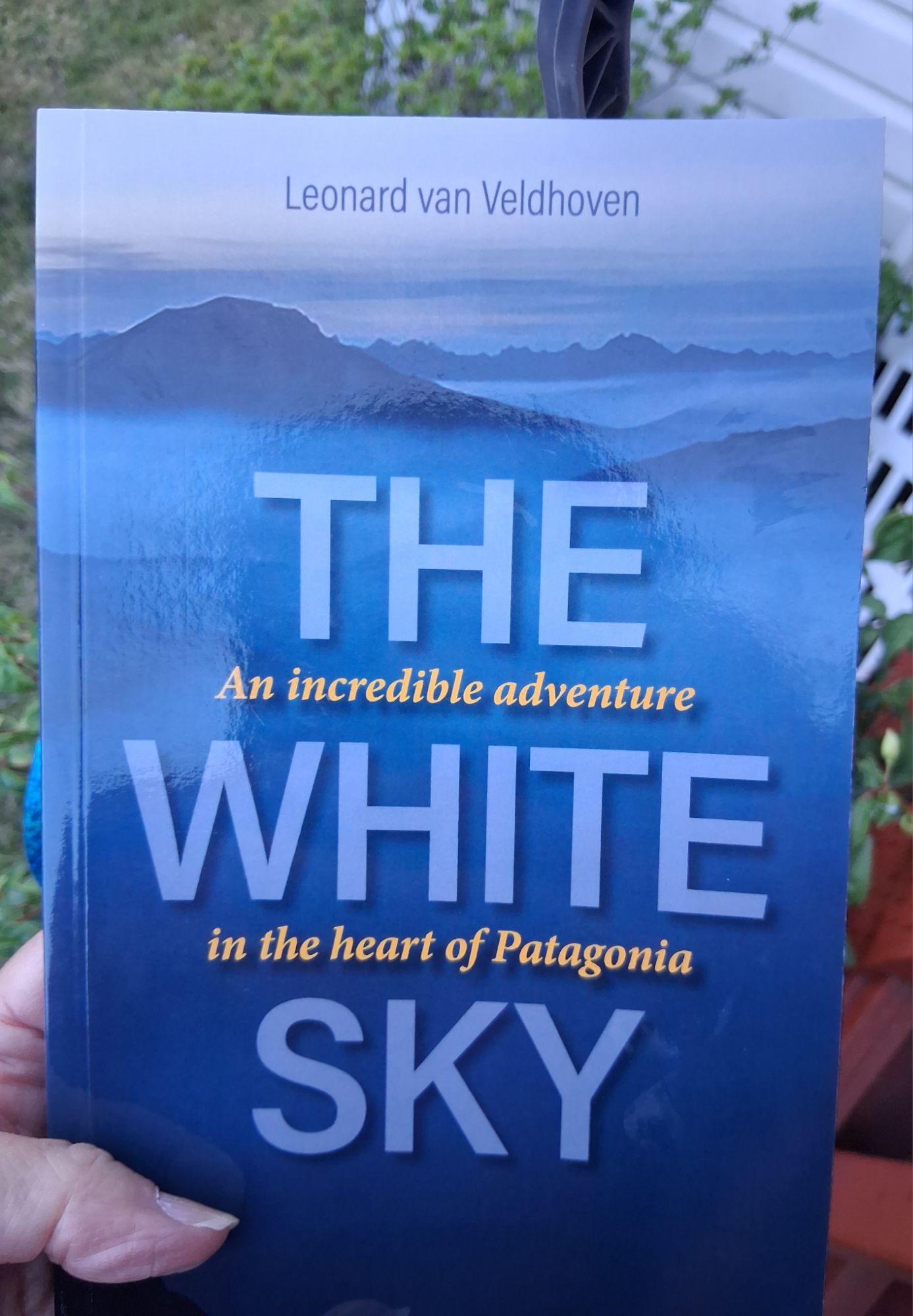
The White Sky: An Incredible Adventure in the Heart of Patagonia
By Leonard van Veldhoven
Genre: No idea
Pages: 253 (About 153 pages too long)
Via: Author request
Note: We received a complimentary copy of this book for honest review.
“I worry about my family and friends. I can hardly imagine never getting out of here. But it could take years, and in the meantime, no one knows I’m still alive.”
Kimber: Worry no longer, bub. Cuz we could care less. Ya see, any time Her Royal Momness and I hear the words” incredible,” “adventure,” and “Patagonia,” we’re all ears! And paws. But not this time. I’ll let Mom fill ya after The Official Marketing Blurb. Like this:
The Marketing Blurb:
Leonardo, the narrator and protagonist, is a seasoned traveler and restless seeker who has journeyed across the Americas and the Pacific―from Easter Island to the scattered isles of Polynesia. While reading Bruce Chatwin’s In Patagonia, he stumbles upon a tantalizing rumor: that ancient Polynesians once sailed eastward, landed in a remote Chilean fjord, crossed the mighty Andes, and settled deep in Patagonia.
A lifelong history enthusiast, Leonardo recalls Thor Heyerdahl’s Kon-Tiki theory―that South Americans may have reached Polynesia by raft. But what if the migration ran the other way? What if Polynesians―legendary navigators of the sea―reached South America long before European explorers?
Driven by a desire to uncover lost truths, Leonardo sets out on a solo expedition into Patagonia’s wild heart. What begins as an intellectual quest soon descends into a harrowing physical and spiritual ordeal. Captured by mysterious people with sun-worn skin, he is blindfolded and transported across the arid, hostile pampas to a lush, hidden valley―enclosed by sheer cliffs, cloaked in a sky of perpetual white cloud, and dominated by a vast lake of geothermally warm water. Towering statues stand guard on a dam at its edge, their weathered faces hauntingly reminiscent of the moai he once saw on Easter Island.
With no chance of escape, Leonardo slowly adapts to life in this secretive community. He forms friendships, falls in love, and begins to document their world, piecing together oral histories of a miraculous migration from Polynesia via Easter Island to this secluded valley.
The Reality
Kimber: Oh, puh-leeze. When we hear “incredible” or “adventure,” we’re thinking amazing. Awesome. Majorly cool. Totally Engaging. High energy and high voltage.
Well. The White Sky is anything but. Here’s why (short version):
The protagonist, Leonardo, is a Dutch visitor to Patagonia. We first meet him as he’s waking up in an Argentinian hospital bed, recovering from a terrible accident. It takes several pages, but we eventually learn how he got there – sort of – and that he was on a quest to learn more about the “White Sky” people noted by a local “padre.”
Around page 60 or so we finally find out that Leonardo was previously kidnapped by Indians. They just happened to speak “Rapanui,” the language of Easter Island. But how? As a captive, Leonardo soon learns that he’s in the land of “Ana-Rangi-Teatea, the Valley-of-the-White-Sky.” (Try saying that ten times, fast. That’s okay. We’ll wait.)
The inhabitants of the valley chose to isolate themselves from the outside world many years ago. They’re concerned about losing their culture if anyone in the Outside World knows they exist. So, the secret of the existence of the Valley-of-the-White-Sky must be “forever preserved.” That means Leonardo can never leave the valley, on pain of death.
The opening chapters are rich in detail and description but it’s still a slow burn. Or maybe a damp burn. With green wood. The story doesn’t really find its footing until about chapter 6 when Leonardo is taken captive. Whether or not most readers will stick around the long is open to question. Speaking of which – sort of – we just could not keep our eyes open for the whole thing. Especially during much of Part II: The Tale. This is basically a rehash of valley people history. In between snatches of Leonardo, his hospital bed, and his daughter.
It’s not an “adventure.” It’s a history lesson that’s as dry as burnt toast.
While highly ambitious, the narrative would benefit from a tighter focus and a more rigorously defined scope to keep readers grounded and engaged. For example, the story suffers from structural deficiencies, continuously jerking readers back and forth from Leonardo in his hospital bed poring over his “notebooks” to pre-injury days spent in the mysterious “white sky” valley. Also, at one point in Chapter IX, we’re hearing Leonardo tell us about White Sky inhabitants, their ancestors on Easter Island, the “Great Statue War,” and the “Birdman Cult.” One paragraph later we’re back to Leonardo chatting with his daughter Mik about her plans to attend a Spanish-Argentinian film about a “famous tango singer” and a police inspector’s backstory.
It’s enough to give a body whiplash.
Meanwhile, the narrative offers the emotional depth and excitement of a damp sponge. Moves with the blistering speed of continental drift. Reads like an instruction manual for a carboard box. A remarkably effective cure for insomnia, the story takes the subject and reduces it to the narrative tension of an IRS tax audit. (Kimber: And that “game” with a dead calf’s head? Barf me.)
Yea, verily. White Sky didn’t just lose our interest; it actively escorted it off the premises.
We made it to about page 150 before bailing out. Could not force ourselves to turn another page. We just have better things to do. Like watching paint peel.
Since we did not finish, we won’t be rating this book. Other than to say calling it an ‘incredible adventure’ is like saying a cup of tea is a boiling ocean.

