
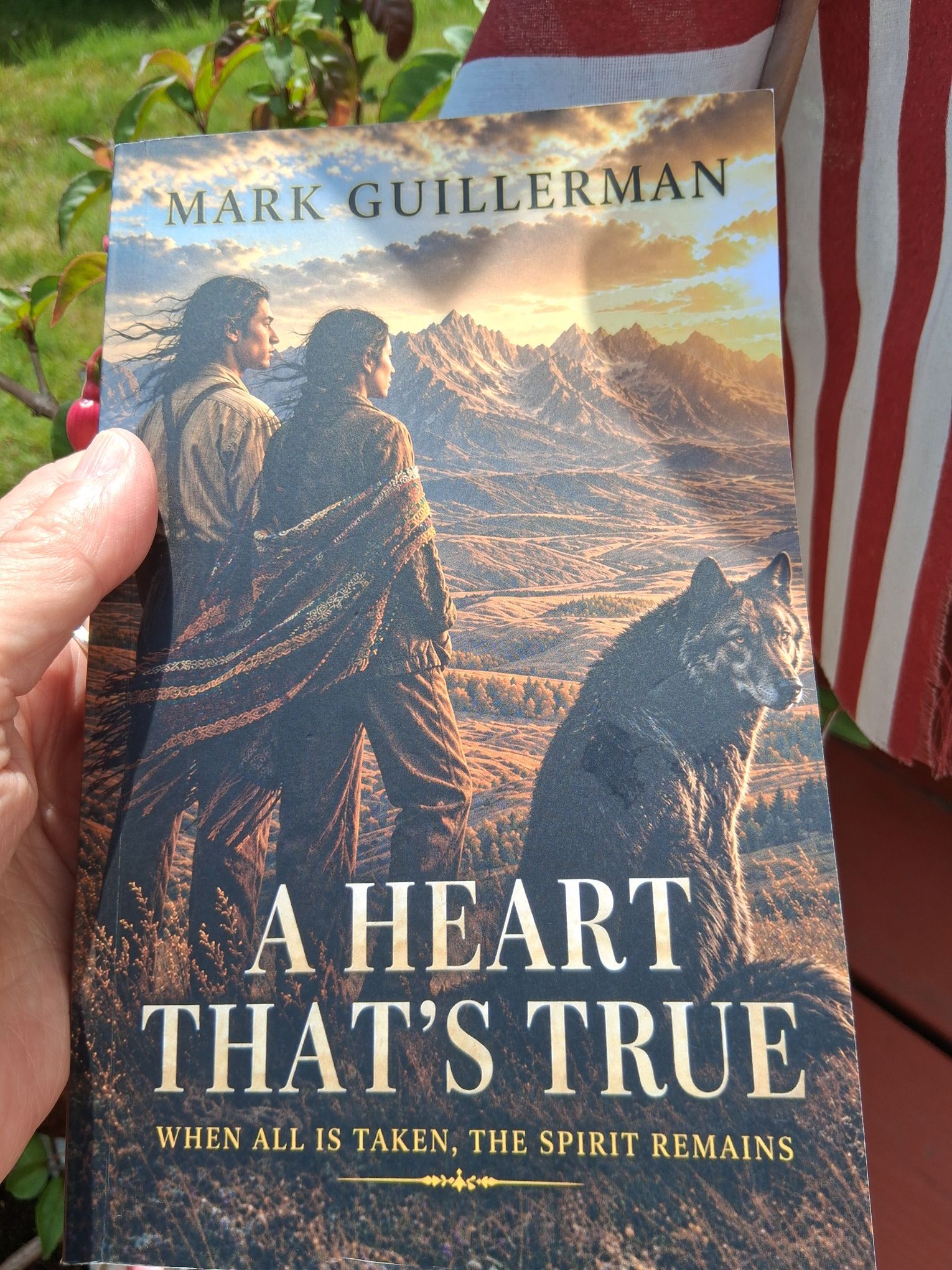
A Heart That’s True: A Native American Historical Novel
By Mark Guillerman (Outskirts Press, 2026)
Genre: Historical Fiction
Pages (Print): 260
Via: Author request
Note: We received a complimentary copy of this book for honest review.
“Remember, the human spirit will never die in a heart that’s true.”
Dateline: Montana, 1910.
Joseph Cross, age 12, and his cousin, Elizabeth White Cloud, are torn from the foothills of Montana and sent across the country to the Carlisle Indian School, where children are stripped of their language, their traditions, and even their names.
Separated from home and forced into a world that sees them as something to be remade, Joseph and White Cloud must learn to survive in ways they never imagined. They face loneliness, danger, and a system determined to erase who they are. Yet through friendship, courage, and the teachings of their people, they begin to discover a strength no one can take from them.
Along the way, their journey becomes intertwined with the legend of Big Black, a powerful wolf/dog whose story mirrors their own struggle to belong in a world that fears what it does not understand.
Set in the “waning days of the Wild West,” A Heart That’s True is a story of resilience, identity, and the unbreakable bond between family, culture, and spirit. It made one of us forget to eat lunch. And dinner. Here’s why:
Besides the top-notch writing and luminous storytelling, this book is balanced. (How refreshing.) There’s both kindness and cold-hearted evil. Like the kindness and generosity of the Johanssens vs. the thuggery of two nasty bounty hunters. And kindly wagon master Sarge McKenna (we kept seeing Rooster Cogburn. But that’s another story). Sarge is handy with a bull whip and a Henry rifle. But to the Lakota Sioux children he’s tasked to transport to the train station and a trip to Pennsylvania and the infamous Carlisle Indian School, Sarge is as warm and gentle as a summer breeze.
Like we said, the kindness of the Johanssen and others is juxtaposed against the brutality of two ruthless bounty hunters, Clyde Baxter and Moondog Burrow. (Even Kimber turned up her nose at these two. And she loves everyone!) But these two putzes give skunks a bad name. And Dex Talbot? Can you say, “scurvy rat”?
Well. We first meet Sarge and the children when they stop their wagon at the Johanssen’s station. The Johanssen’s raise sheep. To fend off roaming wolf packs, they also raise big ‘ole Newfoundland dogs. One of them – the biggest ever – is a pup dubbed “Big Black.” The Johanssen’s soon realize that once the neighbors find out Big Black is half wolf, he’s not long for this world. They hide him as long as they can. But their secret leaks. And they’re faced with a terrible choice. But Big Black makes a choice himself, leaving the Johanssens for the Luna wolf pack. Or at least what’s left of the Luna pack after years of being hunted, poisoned, and seeing no new litters of pups being born.
“They had their rifles and guns, but Big Black had the nighttime.”
What follows is a heartfelt, heartwarming tale of love and loss. Loyalty and treachery. Family. Faith. Resolve. Resilience. Hope. And coming home. It’s a story as warm as a September scirocco. We loved it!
We also loved how the author dovetails the stories of Big Black, Joseph, and White Cloud. The author paints the three tales into a mosaic of color and courage with impressive brushstrokes of narrative skill. Each color complements and deepens the others. We also loved the author’s skillful use of foreshadowing, tension, and conflict. Also, how Jonathan and Etta Mae Taylor and the Porters treat Joseph and White Cloud with kindness as the two children flee the school and head for home. The round-trip tale of landscapes and lives is as compelling as the journey itself.
There’s also Jim Thorpe.
“He was born a Lakota Sioux, and he would pass over a Lakota Sioux. He welcomed Jedidiah as their guide. ‘God provides’ was one of the tenet’s of his grandfather’s teachings.”
Scene stealer: Charley the donkey.
And the cover art? Well. Who can resist that?
When reading a book for review, we usually read with the book in one hand and a pen and a legal pad in the other, taking notes along the way. (We’re old school. Hi, Mom). But we didn’t do that with A Heart That’s True. In fact, we stopped jotting down notes and impressions about halfway through. Why? Because we got so caught up in the story, we forgot everything else. Including lunch and dinner. Again.
“Like a shadow in the night, Big Black crept closer and closer to the camp until he was within a few feet of the fire, just outside the light from the campfire.”
It’s that good. Think Rooster Cogburn meets Call of the Wild and A River Runs Through It. All of which we like, Totally Love-ified. In case you’re wondering, Cookie.
“Many of the citizens of Montana, including the Indian tribe, believed Big Black to be an Indian shaman who could change shapes to avenge the deaths of his tribesmen.”
Finally, A Heart That’s True is the kind of story that kidnaps your attention, holding it ransom until the final page. A seamless blend of tension and intrigue, resilience and redemption, this fine historical fiction novel zips along like a jackrabbit in the wild – quick, energetic, and full of life. Chapters come like finger snaps — instant, decisive, and without hesitation. The narrative pulled us into its world so completely, it made us forget our own. (Kimber: What year are we in, again? Like, today?)
Yea, verily. Again, we like, Totally Love-ified A Heart that’s True. It’s a story that keeps you turning pages, as if history itself is racing to tell its tale. We tiptoed through the final paragraphs like Kimber reaching for the last burger, hoping it would magically multiply.
Cuz we didn’t want it to end.

 Pages & Paws