A Higher Calling is the compelling true story of one couple’s courage and commitment, devotion and faith in the face of high adventure, unexpected adversity, and spine-tingling danger.
Co-authored by Harold and Rachel Earls, Higher is equal parts biography/memoir, love story, epic adventure, travelogue, and faith-journey. It’s a delightful, uplifting read about two people who sacrifice much to achieve a common goal: summiting personal and actual “Mount Everests.”
Kimber here. Mom says it’s time for a reading wrap-up. That’s when she does her version of recently read hits and misses. Why? So you can avoid the dumpster fires. Not waste your time on doggie doo-doo that some fluff ball who couldn’t track kibble with two noses published. And grab some Good Stuff.
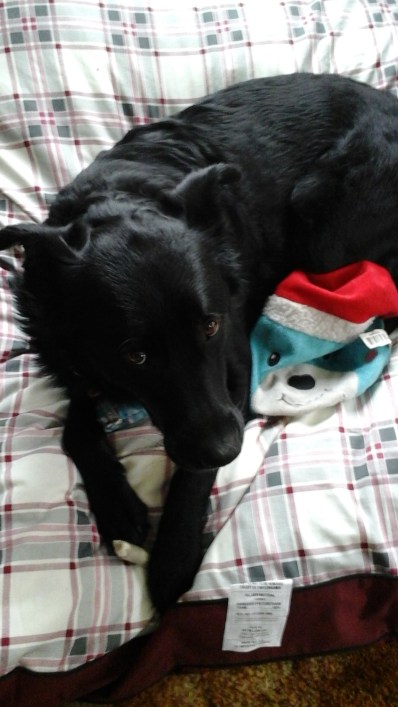
Me? I’m going to catch up on some zzzzs from the delicious comfort of my brand-new doggie bed, courtesy of MyPillow. (Thanks, Mom! You’re Awesome!)
But first, to books! The stinkers first. These are the titles you don’t need to waste your time on (aka, The Bad, and the Really, Really Ugly):
Have you ever re-discovered a book from your childhood that still has the power to move and profoundly impact you, even a half century after your initial read? If so, then you’ve found a true classic.
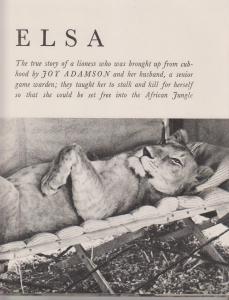
Evocative and compelling,Born Free is the remarkable true story of Elsa, an orphaned lion cub raised by Joy Adamson and her husband, George. At its core, Born Free is a love story. With great sensitivity and precision, Adamson chronicles the mutual affection and bond between a magnificent lioness and the humans who loved her enough to release her to the Kenyan wilds where she was free born.
It’s probably the most moving and inspiring “animal story” I’ve ever read.
Joy Adamson wrote three books about African lions: Born Free, Living Free, and Forever Free. I read them all. Born Free is my favorite.
I first read Born Free in 1969, nine years after it was first published. I was in the fifth grade. Entranced, I read it over and over. There’s something timeless and transcendent about the story that’s difficult to put into words.
I lost track of Adamson and Elsa over the years. But I never forgot the extraordinary story of a free born lioness and the humans who loved her. I recently located a library copy of Born Free. Finally.
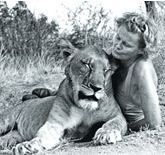
Elsa and “Born Free” author Joy Adamson.
Opening the Forward to the Fortieth Anniversary Edition (2000), I was startled to learn that Joy Adamson was stabbed to death by a disgruntled former employee in 1980. The news hit me like a ton of bricks. I felt like I’d lost a best friend I’d never met. So it was with a mixed sense of sadness and reverence that I sat in a sun-soaked living room in a far corner of the Olympic Peninsula nearly thirty years after that sad event and re-opened a book that profoundly impacted my life, especially with regard to animals.
Lavishly illustrated with black and white photographs, Elsa’s story is still an unforgettable one. So is Adamson’s prodigious writing talent. Her breezy, bucolic style recalls another formidable literary talent who writes so evocatively about her life in Kenya: Isak Dinesen. Like Dinesen, Adamson’s descriptions of her life as the wife of a senior game warden in East Africa have a luminous quality that is almost melodic.
My favorite photo from the book. Joy Adamson and Elsa.
I read Born Free cover to cover in one sitting. Here’s a key line, from page 109:
“Her (Elsa’s) good-natured temperament was certainly due in part to her character, but part too may have come from the fact that neither force nor frustration was ever used to adapt her to our way of life. For we tried by kindness alone to help her to overcome the differences that lie between our two worlds.”
The Adamsons and Elsa succeed beyond all expectations.
Re-reading the last chapter, The Final Test, the same intense sense of sadness and loss these pages evoked in me five decades ago bubbled up again from some deep internal well. It was as if Elsa and her human pride had never left, patiently waiting 50 years for my return to their story.
Recording Elsa’s success in finding her own wild pride and mate, Adamson writes:
“We returned to camp alone, and very sad. Should we leave her now, and so close a very important chapter of our lives?”
The Adamsons decide to wait “a few more days” to make sure Elsa has been accepted by the pride.
In the final elegiac paragraph, Adamson returns to her “studio” by the river to continue writing the story of Elsa, “who had been with us until this morning.” Sad to be alone, the author writes that she tries to make herself happy “by imagining that at this very moment Elsa was rubbing her soft skin against another lion’s skin and resting with him in the shade, as she had often rested here with me.”
“Not for the faint-hearted” is perhaps over-used, but in the case of Frank McCourt’s memoir of his growing up years, Angela’s Ashes, it is apt. (“Angela” is his mother’s name.)
The son of an alcoholic Irish man, McCourt paints a gritty picture without a brush of self-pity. The prose is genuine and so gritty you can almost hear McCourt’s brogue singing through each page as he recounts life in a tumbledown shack on “the lane” in Ireland that floods and freezes in winter and swarms with fleas and stink in the summer.
His story begins in America, but soon high-tails it back to Ireland, where he details a professional unemployed father, grim family members, the loss of a baby sister, two twin boys, “the hunger” as well as the “Angel on the Seventh Step.” It’s all there – the almost unbelievable poverty, hunger, filth, disease, despair, religious superstition.
In spite of a childhood chockfull of incredible hardship, deprivation, cruelty and misery, there’s something transcendent and luminescent about McCourt’s story. Even with typhoid fever, “the shame,” and his father’s habit of “drinking his wages on the pint,” McCourt refuses to sink into a slough of despond or bitterness. Plucky Frank (short for Francis, “after the saint”) pulls himself up by own bootstraps and does so in an engaging, almost lyrical manner that’ll have you cheering – and perhaps shedding a tear or two – by the end of this remarkable, heart-breakingly heroic Pulitzer Prize Winner.
I expected better from John Grogan. I loved the pithy insights from his first book, Marley and Me, as well as his richly textured three-dimensional word pictures, nimble pacing and quirky chronicling. Cynical, sour, and almost suffocatingly self-serving, The Longest Trip Home is a like a stiff shot of castor oil after a Florida-sized slice of cherry cheesecake.
Grogan’s “memoir” is coarse, self-absorbed and worst of all, tedious, eliciting the pizzazz of a plate of overcooked cabbage. It’s essentially 300-plus pages of an anti-Catholic rant in which the author chronicles – and chortles at – his parents’ “Medieval interpretation of Catholicism, with its literal belief in guardian angels hovering over our shoulders to protect us from the dark agents of Satan,” which, among other things, “strikes both him and his wife, Jenny, as “as almost comically superstitious.” This narcissistic romp though the author’s sexual conquests – both real and imaginary – also includes the horrors of Catholic school, altar boy service, and so on until the author smugly self-identifies himself as a “non-practicing Catholic.”
After grinding out twenty-four chapters running down his parents’ faith while simultaneously patting himself on the back for deceiving and misleading them about his behavior, mores and mindset for most of his growing up years, Grogan then seems baffled by his parents’ sense of hurt and betrayal when he finally comes clean as a thirty year-old about to be married to a non-Catholic. He crows about how he has “Finally broken free from my parents’ influence” and “no longer felt the need to lie and obfuscate” and seems to think a crate of champagne is in order. While Grogan crows about being “unapologetically my own person now…,” readers may wonder why we should care. (I’m not Catholic, but still found this stuff tedious and bloated.) And did we really need to know every sordid detail about his Sister Mary Lawrence fantasies – as a second grader?
Although Grogan spends two-thirds of the book – 234 pages- ridiculing and belittling his parents’ staunch Catholicism and conservative views, Longest retains a glimmer of Grogan’s past panache. In Part Three, Coming Home, the author seems to be trying to make up for the past 24 chapters by devoting 91 pages to some sort of penitential “maybe they were right” musings. A trace of Grogan’s former prose prowess shines forth in the final chapters as he softens his stance while his mother and father succumb to old age, frailty and illness. His tenderness toward his dad who is dying of leukemia and pneumonia is heartfelt and deep, but in a case of “too little, too late,” Grogan doesn’t quite pull it off. Instead, he leaves the reader wondering if he’s “come home” to stay or if this is just another pit stop en route back to the land of “lies and obfuscation.” What’s puzzling – and disappointing – is that the author is capable of much better.




 Pages & Paws