Pages & Paws

Writing, Reading, and Rural Life With a Border Collie


1 Comment

What Do Spartacus and 5 Dragonets Have in Common?

Wings of Fire: The Dragonet Prophecy

By Tui T. Sutherland
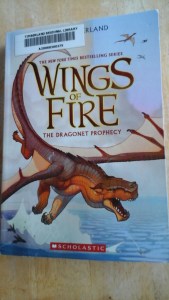
 

You know that “We who are about to die salute you” gladiator scene in Spartacus? Where Kirk Douglas is forced to duke it out to the death with another gladiator?  Add some scales, talons, and wings. Stir in five dragonets who are the only hope for peace between endlessly warring dragon tribes. And you’ve got the gist of Tui T. Sutherland’s Wings of Fire: The Dragonet Prophecy. It’s Book 1 of a 12-book fantasy novel series set in the mythical land of Pyrrhia.


Plot Summary

A war has been raging between the dragon tribes of Pyrrhia for years. MudWing dragonet Clay and four other dragonets have lived their entire lives – six years – under a mountain. Purloined from their homes as eggs, the quintet has been hidden from the rest of the world until they’re ready to fulfill their destiny. According to a mysterious Prophecy, five dragonets will end the bloodshed and choose a new queen.


Or will they?


When Clay and his spunky buddy, Tsunami, make a daring escape and return to rescue the others from their subterranean existence, everything kind of goes sideways. Inches from freedom, plucky Clay and his friend are captured by the deadly SkyWing dragon queen, Scarlet. She forces her prisoners into to-the-death gladiator battles reminiscent of Spartacus. (See? I told you so.)


Queen Scarlet’s champion is an undefeated SkyWing named Peril. She responds to Clay’s kindness. But is Peril friend or foe? And who will become queen?


Wit and Humor

A rapier wit and subtle humor enliven this delicious fantasy tale. Sutherland’s world-building is also first-rate. You can almost hear fire sizzle, smell the musty earth and feel the waves of an icy river and waterfall lap at the pages.


The plot picks up speed quickly as “huge, handsome idiot” Clay and his pals battle to escape Queen Scarlet’s evil clutches and search for their own families while trying to unravel their intertwined destinies. A fun read for older elementary or middle schoolers or anyone who enjoys exploring fantasy worlds, dry humor and traipsing in and out of dragon lairs.


Don’t Eat the Block Rocks

Along the way we learn that old scrolls and dusty lectures can come in handy. Eating black rocks from the Diamond Sky River turns out not to be such a great idea. Peril and the Champion Shield uncover a secret.


You should also know that there’s more than one kind of dragon in Pyrrhia. The different dragon tribes are: SandWings, MudWings, IceWings, RainWings, and NightWings. And not every dragon breathes fire.


One other thing: Mud isn’t just for squishing in.


Keep An Eye Out

One other, other thing. And this is kind of important. Not every dragon wants the Great War to end. Like Burn. And what’s up with Morrowseer? I’d also keep an eye on Blister, ‘fize you.


But I’m getting ahead of myself.


Is this unlikely band of rag-tag dragonets really destined to fulfill a mighty Prophecy, or are they just being lured out into the open where evil stalks their every move and treachery awaits…?


Oh, the dragonets are coming

They’re coming to save the day…

 

3.0


For more on our rating system, click here.



Leave a comment

Is ‘The Porpoise’ This Bad On PURPOSE?

The Porpoise

By Mark Haddon

Doubleday, 2019


If you don’t have anything better to do – like watch paint peel – check out a Catcher in the Rye Meets Flipper & Faulkner Wannbee. It’s called The Porpoise.

Plot Summary

The sole survivor of a plane crash that killed her mother, Angelica is raised by her insanely rich, overprotective father, Philippe. More of a nutcase with “issues” than he a grieving widower, the guy’s a first class Creepazoid.


Angelica grows up in about 40 pages.  Rumors swirl around the isolated daughter of breathtaking beauty. When a potential suitor, Darius, arrives, he guesses more than he should. He winds up hightailing it out of Daddy’s swank digs fast, with an assassin on his tail. Darius runs for his life aboard a boat, The Porpoise.


“Darius”? Seriously?


Says one breathless reviewer: “And then, over several extraordinary pages, he sails out of contemporary Britain and into ancient mythology, shedding his old self and becoming Pericles in the process.”


Snooze Alert

Great. A modern-day Don Juan wannbee who thinks he’s Pericles fleeing an abusive dad while trying to navigate into a Greek legend.

Yep. It’s that bad. A fact that does not go unnoticed by the Encyclopedia Britannica:


Pericles, play in five acts by William Shakespeare, written about 1606–08 and published in a quarto edition in 1609, a defective and at times nearly unintelligible text that shows signs of having been memorially reconstructed. …The play was based on the Classical tale of Apollonius of Tyre.


“Defective” and “nearly unintelligible text” is right.

Flickr

Gag Me

The Porpoise is supposedly based on Shakespeare’s play which is based on the legend of Apollonius. The brittle, overwrought and often unintelligible Porpoise also seems to be in the running for One Flew Over the Cuckoo’s Nest, Part II. As do George Wilkins’s clogged arteries.


It’s almost as if the author is so desperate to impress, he dumps every literary dust mote ever dashed onto papyrus and swashes them onto the page in one fell swoop. (If I want Shakespeare I’ll get the original, thank you very much.)


Then it’s back to Angelica, silent again. Oh, and she stops eating, too. By this time, however, she’s pretty much a footnote to a story that lurches onward focusing on Darius/Pericles.


Land, ho! Naw. Just kiddin’.


Limping Along & Anchorless

Anchor-less, the author can’t seem to decide who his protagonist is or which end is up. So he just wanders around aimlessly, spilling out endlessly descriptive passages like bread crumbs to voracious sea gulls for no discernible reason. Cuz lemme tell ya, baby. That habit neither propels nor rescues the stilted and largely incoherent story that’s already limping along on legs as wobbly as a newborn colt’s.

Pexels Stock Photo

The result is a prattling, incoherent sop that makes Benjy Compson look eloquent. (To the horror of high school English teachers everywhere, I’m not a big Faulkner fan. But Porpoise isn’t even a good knock-off of Faulkner or The Bard. That’s why I’m not linking to it. On porpoise. That’s not a typo.)


Sure, the back cover is peppered with effusive praise. But so was Proust.


Hopelessy Obtuse

With a hopelessly obtuse plot that just tries too hard, this load of horse hooey ranks right up there with a tale told by an idiot, full of sound and fury signifying nothing.


Indeed, it’s been years since I slogged through a book this bad. Don’t waste your time. I already did. With apologies to Flipper.


0


For more on our Rating System, click here.


Leave a comment

Review of “Michael Vey: The Prisoner of Cell 25”

Michael Vey: The Prisoner of Cell 25

By Richard Paul Evans

“Is this like a series?  When’s the next one coming out?  Can we get it tomorrow?”

High praise for any book, but coming from my twelve year-old son?  We’re talkin’ statospheric.  I mean, I had to arm-wrestle the kid for Richard Paul Evans’s new release, Michael Vey: The Prisoner of Cell 25.   Good thing I’m a fast reader.  I zoomed through all three hundred and twenty-six pages in two days.

I’m not kidding.  Vey is a barn burner.  Page-turner.  Whatever.

Fourteen year-old Michael Vey is smack in the middle of life’s “armpit”: freshman year at Meriden High School.  He seems like an incredibly “average” kid.  The only thing that may set him apart is furious eye-blinking when he’s nervous, attributable to Tourette’s syndrome.  Michael’s one – and only – friend is portly, resourceful brainiac Ostin (he was born in Texas.  His mom was a poor speller.  Figure it out.).

Michael would like nothing better than to be left alone and just try to survive high school, but a trio of local thugs won’t let him.  They’re among the first to encounter Michael’s secret first-hand when they try “pantsing” him after school as cheerleader and drop-dead gorgeous Taylor walks by.

Michael later finds out that he and Taylor aren’t as different as he thought.  They both share special electrical powers. Michael, Ostin and Taylor form the “Electroclan.” Everything’s going swimmingly until Ostin detects some coincides between Michael and Taylor that are way too similar for mere coincidence – like the fact that they were born in the same hospital, in the same state, a day apart, and that nearly all other babies born in the same hospital within that time frame died.  The trio sets out to find out why.  In the process, they stumble upon the “Who?” – and wish they hadn’t.  Enter the darkly sunglassed, mysterious Dr. Hatch.

A megalomaniac par excellence, the ‘ethically challenged’ Hatch (that’s an understatement) has been looking for Taylor and Michael for nearly fifteen years.  When Michael’s mom is kidnapped, as is Taylor,  it’s up to Michael and Ostin to launch a daring rescue against seemingly overwhelming odds.  They must rely on wit, tenacity and each other to succeed.  But who can they trust to help?  Who else is after them, and what do they want?  Will the boys arrive before it’s too late?  And what happened to Michael’s dad?

Evans has ranked high on my Favorite Authors short list for years, ever since The Christmas Box.  As a YA novel, Vey represents a significant departure from Evans’s usual themes and treatments. It’s a different “cup of tea.”  Very different.  And Evans pulls it off beautifully!  The story is a skillful combination of action, suspense, mystery, romance, science and humor into an imaginative fiction with characters that are real and genuine.  We want to meet them again.  The plot is engaging, brisk and clever.  A keeper!

And the next title in the Vey series, The Rise of Elgen?  Not to worry.  My son and have it on hold at the library.  In fact, we’re first in line.


Leave a comment

Review of ‘The Last Summer of the Death Warriors’

The Last Summer of the Death Warriors

By Francisco X. Stork

Seventeen year-old Pancho is one tough hombre.  And he’s royally ticked.  With a deceased mother, his father recently killed in a work-related accident, and his mentally challenged sister, Rosa, dead, he lands in a New Mexico orphanage mad at the world and aiming to make the world pay.  Detectives say Rosa’s death was due to “natural causes,” but Pancho suspects foul play.  He formulates a plan to identify Rosa’s killer and wreak his revenge.

Pancho encounters an unexpected wrinkle when he meets D.Q. (Daniel Quentin) at the orphanage.  D.Q. has authored “The Death Warrior Manifesto.”  (“Rule number one: No whining.”)   Impish, intellectually buoyant and devilishly mischievous in spite of a cancer diagnosis, D.Q. pegs Pancho to be a fellow “death warrior.”  The Panda (priest) who runs the place assigns Pancho as D.Q.’s helper for the summer, a prospect that thrills Pancho about as much as a cat in cold bath water.  Will he choose death and revenge or the way of the “death warriors” – fighting for every last shred of life and love as long as they last?

Francisco Stork’s young adult novel is gutsy.  It asks tough questions and avoids patty-cake, trite answers.  It engages quickly, combining elements of both a murder mystery and a romance story as main characters battle doubt, disease, abandonment, despair and their own inner demons.  The novel is artfully written with realistic, three-dimensional characters and crisp dialogue (may be too gritty for gentle readers).  A unique story with some unusual plot twists, Last Summer is worth a look.


Leave a comment

Review of ‘Lost December’

He’s amazing.  Just when I think he’s penned his final shimmering literary star, Richard Paul Evans flings another into the firmament of fine fiction.  Lost December (Simon & Schuster, 2011) is a case in point.

I loved this book.*    I read all 346 pages cover-to-cover in a day and a half, including the Epilogue.

Based on the biblical account of the prodigal son, Lost December introduces us to Luke Crisp, son of copy center mogul Carl Crisp.  Dad wants to turn the family business over to his son once Luke earns his M.B.A. from Wharton, an endeavor Dad urged Luke to pursue.  At Wharton, however, Luke falls in with would could be charitably dubbed a bunch of nihilist husks of humanity masquerading as intellectuals and fellows students.  Under their influence and at the urging of his smooth-talking, blood-sucking leech of a “room mate,” Sean, Luke has other plans.  He dumps Dad’s business – and Dad – and jet-sets to Europe with his new pals, footing the bill for everyone.  Once on the continent, Luke and friends make a career out of running up outlandish bar tabs and room service.  But Luke’s million dollar trust fund doesn’t last forever.  When the money runs out, so do his “friends.”

Luke returns to Las Vegas and soon hits rock-bottom.  Friendless, penniless, and homeless, Luke Crisp is the highly educated son of a Fortune 500 corporate exec. whose entire worldly possessions fit into the backpack he carries from one street to the next.

Too embarrassed and ashamed to contact his father, Luke winds up living “underground” in a culvert.  After being robbed and beaten up, Luke is rescued by Carlos, a Good Samaritan who runs a convalescent care center.  Carlos gives Luke a place to stay and hires him.  Luke soon takes on a second job at a local Crisp’s Copy Center, where no one knows who his father is – and he’s not about to spill the beans.  He comes closes when he meets the distant, detached Rachael, a single mom with a painful past.

What follows is a remarkable, poignant story of forgiveness, reunion and the true meaning of love.

Told in vintage Evans style – first person narrative, with an engaging, intriguing plot and three-dimensional characters you feel like you know – Lost December is a holiday treat.  Get a copy for yourself this holiday season.  Better yet, get several and share.

*  I admit it.  I love all of Evans’ books.  If you have a “reluctant” teen reader, check out Evans’ Michael Vey: The Prisoner of Cell 25.  My twelve year-old couldn’t put it down!


Leave a comment

Review of ‘Every Last One’ by Anna Quindlen

Every Last One

By Anna Quindlen

Random House, 2010

She’s done it again.  In Every last One best-selling author Anna Quindlen offers yet another poignant mixture of panache and pathos as she traces the effects of seemingly inconsequential choices and actions that turn out to be life-altering.

Every may get off to a slow start, but its gathers steam quickly as we’re introduced to Mary Beth Latham, husband Glen and their three incredibly average teenage kids: popular over-achiever Alex; introverted, morose Max; and independent, free-spirited Ruby.  Neck-deep in “the usual” – proms, soccer games, high school angst, sibling rivalries, curfew, family dinners and sibling spats – this “typical” suburban family turns out to be anything but.  Just about the time the reader starts feeling lost in the dull monochrome of what could be the average American family – as in, ‘been there, done that’ – Quindlen tosses us a curve.  A big one.  The pacing is perfect.

The rest of this remarkable book focuses on how Mary Beth and her girlfriends such as no-nonsense Nancy and “English rose” Olivia help her cope with an immense tragedy. We also discover what’s eating Mary Beth’s former friend, Deborah.  Like the consummate storyteller she is, Quindlen weaves a rich tapestry of roles and relationships that are almost excruciatingly authentic.

Besides the carefully crafted plot and three-dimensional characters, the dormant strength of Every Last One – a phrase uttered by a police officer on one tragic New Year’s Eve – lies in its “every person” appeal.  Readers may feel they know the Lathams.  Maybe this ophthalmologist’s family is their neighbor, colleague, coach, or their kids’ favorite hang-out site.  Or maybe it’s them.  This complicated, beautifully drawn story of struggle, survival, unspeakable loss and love is weft as tight as a Persian rug, and is just as exquisite.  I read the LP version (385 pages) cover to cover in a day and a half.

Full of unexpected twists and turns, Every Last One is another stellar work of fiction like the kind we’ve come to expect from Quindlen.  Much of its strength lies in sturdy characters, believable dialogue and its subtle message of hope.  This one’s a keeper.

***

Coming soon: A review of the autobiographical Lessons from the Mountain: What I Learned from Erin Walton, by Mary McDonough.