Pages & Paws

Writing, Reading, and Rural Life With a Border Collie


Leave a comment

Review of ‘Every Last One’ by Anna Quindlen

Every Last One

By Anna Quindlen

Random House, 2010

She’s done it again.  In Every last One best-selling author Anna Quindlen offers yet another poignant mixture of panache and pathos as she traces the effects of seemingly inconsequential choices and actions that turn out to be life-altering.

Every may get off to a slow start, but its gathers steam quickly as we’re introduced to Mary Beth Latham, husband Glen and their three incredibly average teenage kids: popular over-achiever Alex; introverted, morose Max; and independent, free-spirited Ruby.  Neck-deep in “the usual” – proms, soccer games, high school angst, sibling rivalries, curfew, family dinners and sibling spats – this “typical” suburban family turns out to be anything but.  Just about the time the reader starts feeling lost in the dull monochrome of what could be the average American family – as in, ‘been there, done that’ – Quindlen tosses us a curve.  A big one.  The pacing is perfect.

The rest of this remarkable book focuses on how Mary Beth and her girlfriends such as no-nonsense Nancy and “English rose” Olivia help her cope with an immense tragedy. We also discover what’s eating Mary Beth’s former friend, Deborah.  Like the consummate storyteller she is, Quindlen weaves a rich tapestry of roles and relationships that are almost excruciatingly authentic.

Besides the carefully crafted plot and three-dimensional characters, the dormant strength of Every Last One – a phrase uttered by a police officer on one tragic New Year’s Eve – lies in its “every person” appeal.  Readers may feel they know the Lathams.  Maybe this ophthalmologist’s family is their neighbor, colleague, coach, or their kids’ favorite hang-out site.  Or maybe it’s them.  This complicated, beautifully drawn story of struggle, survival, unspeakable loss and love is weft as tight as a Persian rug, and is just as exquisite.  I read the LP version (385 pages) cover to cover in a day and a half.

Full of unexpected twists and turns, Every Last One is another stellar work of fiction like the kind we’ve come to expect from Quindlen.  Much of its strength lies in sturdy characters, believable dialogue and its subtle message of hope.  This one’s a keeper.

***

Coming soon: A review of the autobiographical Lessons from the Mountain: What I Learned from Erin Walton, by Mary McDonough.

Leave a comment

‘because of mr. terupt”: extradordinary (“dollar word”?)

Lisa was right.  Our intrepid Children/Youth Services Librarian usually is.

Roaming the stacks of my local library the other day, I couldn’t quite find “It.”  You know, a title that leapt off the stacks, grabbed me by the throat and hollered, “Read me!”  (Some do, you know.)  So I moseyed over to Lisa’s desk for a recommendation.  She understands my conviction that some of the finest writing and best literature on the planet can be found in Children’s or Young Adult sections because frankly, any author that can catch and keep a kid’s attention for an entire book must be doing something right!

Anyway, Lisa steered me toward because of mr. terupt (Random House, 2010), Rob Buyea’s debut novel.  “You will absolutely love this!” she chirped.

Lisa was right.  I finish a book a week on average.  Terupt is quite possibly the best thing I’ve read all year.

This clever, engaging story is narrated by seven kids in Mr. Terupt’s fifth grade class at Snow Hill School, Connecticut.  Each has a unique “signature” headlining their own chapter – and perspective.  There’s portly, sensitive Danielle; conniving, manipulative Alexia; bookish Jessica, newly re-located from California; Jeffrey, who detests school; Anna, who’s ostracized because of her home life; Peter, the class clown and mischief-maker, and Luke, the brain.

A first-year teacher who is much more than a classroom instructor, Mr. terupt teaches each kid not only how to calculate “dollar words,” the number of blades of grass in the school soccer field or what not to feed a plant experiment, but also about cooperation, compassion, loyalty, faith, forgiveness and courage in the face of overwhelming odds.

mr. terupt is packed with enough plot twists and turns to rival a ride down Disneyland’s Space Mountain.  Whizzing down the slopes from chapter one, the story snowballs into an avalanche of real emotion: fear, guilt, anger, love, courage and hope. The characters are so genuine and three-dimensional, you may feel like you sat next to some of them in your own fifth grade class.  Engrossing and brisk, the story has you ready to spit or pump both fists in the air one minute, then tearing up the next.  I finished all 268 pages in a day and a half.

Lisa was right: I loved because of mr. terupt.  I bet you will, too.  (Bring Kleenex.)


Leave a comment

Review of “The Longest Trip Home”

The Longest Trip Home: A Memoir

By John Grogan

HarperCollins, 2008

ISBN: 978-0-06-171324-8

I expected better from John Grogan.  I loved the pithy insights from his first book, Marley and Me, as well as his richly textured three-dimensional word pictures, nimble pacing and quirky chronicling.  Cynical, sour, and almost suffocatingly self-serving, The Longest Trip Home is a like a stiff shot of castor oil after a Florida-sized slice of cherry cheesecake.

Grogan’s “memoir” is coarse, self-absorbed and worst of all, tedious, eliciting the pizzazz of a plate of overcooked cabbage.  It’s essentially 300-plus pages of an anti-Catholic rant in which the author chronicles – and chortles at – his parents’ “Medieval interpretation of Catholicism, with its literal belief in guardian angels hovering over our shoulders to protect us from the dark agents of Satan,” which, among other things, “strikes both him and his wife, Jenny, as “as almost comically superstitious.”  This narcissistic romp though the author’s sexual conquests – both real and imaginary – also includes the horrors of Catholic school, altar boy service, and so on until the author smugly self-identifies himself as a “non-practicing Catholic.”

After grinding out twenty-four chapters running down his parents’ faith while simultaneously patting himself on the back for deceiving and misleading them about his behavior, mores and mindset for most of his growing up years, Grogan then seems baffled by his parents’ sense of hurt and betrayal when he finally comes clean as a thirty year-old about to be married to a non-Catholic.  He crows about how he has “Finally broken free from my parents’ influence” and “no longer felt the need to lie and obfuscate” and seems to think a crate of champagne is in order.  While Grogan crows about being “unapologetically my own person now…,” readers may wonder why we should care.  (I’m not Catholic, but still found this stuff tedious and bloated.) And did we really need to know every sordid detail about his Sister Mary Lawrence fantasies – as a second grader?

Although Grogan spends two-thirds of the book – 234 pages- ridiculing and belittling his parents’ staunch Catholicism and conservative views, Longest retains a glimmer of Grogan’s past panache.  In Part Three, Coming Home, the author seems to be trying to make up for the past 24 chapters by devoting 91 pages to some sort of penitential “maybe they were right” musings.  A trace of Grogan’s former prose prowess shines forth in the final chapters as he softens his stance while his mother and father succumb to old age, frailty and illness.  His tenderness toward his dad who is dying of leukemia and pneumonia is heartfelt and deep, but in a case of “too little, too late,” Grogan doesn’t quite pull it off.  Instead, he leaves the reader wondering if he’s “come home” to stay or if this is just another pit stop en route back to the land of “lies and obfuscation.”  What’s puzzling – and disappointing – is that the author is capable of much better.


Leave a comment

‘I am not SPOCK’: Going where no Vulcan has gone before

I am not SPOCK

By Leonard Nimoy

Buaccaneer Books, Inc. 1975

ISBN: 1-56849-691-5

Actor.  Photographer.  Political activist.  Poet.  King Arthur.  Extra-terrestrial.

What are the chances these words can all be connected to one person?  In the case of Leonard Nimoy, the chances are high because he is all of the above.  And much more.

Skimming the Biography section of the local library the other day, a slim black volume caught my eye.  Maybe it was because I was sitting on the floor, trying to escape the notice of a marauding band of sticky-faced toddlers, and the book’s spine just happened to be at eye level.  Maybe it was because my youngest son, age 11, had just checked out the third season of Star Trek on DVD.

Whatever the reason, I picked up I am not SPOCK, checked it out and read Leonard Nimoy’s brief, engaging memoirs in a couple days.  It’s an enjoyable, occasionally quirky read, providing a glimpse into a complicated and gifted artist who’s much more than a pointy-eared Vulcan  pronouncing “fascinating” with raised eyebrow.

While Nimoy chronicles some of his creative differences with scripts, producers and directors of the ST series, “never was heard a disparaging word” about any other ST cast member.  He tells us about some of his favorite scenes and episodes from the series as well as some of his disappointments in character development and effective dramatic interactions.  Without acrimony, he describes a perceived dip in quality during the show’s third and final season and what it felt like to be hurried off the Paramount lot within days of ST’s production shutdown.

Nimoy also discusses his post-Star Trek work on Mission: Impossible (remember that?), big screen ventures, Shakespearean theater, and subsequent roles as King Arthur in Camelot, the king in The King and I, McMurphy in One Flew Over the Cuckoo’s Nest and his special delight in playing Tevye in Fiddler on the Roof. (As a native San Diegan, I took special notice of his descriptions regarding his work with San Diego’s renowned Old Globe Theatre in Balboa Park)

We meet some of the ST cast and crew in I am not,  but we don’t stay aboard the Enterprise long and are soon introduced to Yul Brynner, Richard Crenna, Martin Landau, Isaac Asimov and others.  Nimoy avoids narrating such interactions in a pompous “me, too” manner and sticks to matter-of-fact narrative, often rimmed with dry humor and pithy observations.  He also includes a humorous exchange between himself and pediatrician Dr. Benjamin Spock at an ACLU conference.

As an actor, Nimoy demonstrates his devotion to quality as he is always on the lookout for new roles and challenges.  As a person, Nimoy provides glimpses into his family and home, travels, personal appearances, Jewish roots, interactions with “fans,” political interests and activities, and a creative, complex personality that truly has gone where no Spock has gone before.  As example is Nimoy’s inclusions of imaginary dialogue between Nimoy and Mr. Spock, such as:

NIMOY: Spock, … how does it feel to be popular?

SPOCK: I do not have feelings.

NIMOY: I’m sorry.  I didn’t mean to offend you.

SPOCK.  I am not offended.  I understand your tendency to judge me by your human standards.  It would however, facilitate matters if you would refrain from doing so.

NIMOY: I’ll try… Are you aware that you are popular?

SPOCK: I am aware of a certain public interest that exists.

NIMOY: People like you.  Do you care about that?

SPOCK: Should I?

And so on.

More than thirty years have elapsed since I am Not SPOCK was published.  By the final chapter, Live Long and Prosper-L’Chaim, we’d like to pour a second cup of coffee for another “kitchen table” chat with an old friend.


Leave a comment

Storyteller, Not Decorator

“My advice to writers yearning for publication is to minimize description, and be sure you don’t stop the story while describing.  You are a storyteller, not an interior decorator.” – Sol Stein, Stein on Writing

A Little Lowder * Twitter * Facebook


Leave a comment

‘cold tangerines’: keep your eyes out for another serving

cold tangerines: celebrating the extraordinary nature of everyday life

By Shauna Niequist

Zondervan, 2007

I needed this book.  I didn’t realize it until about halfway through, but “better late than never.”

Painted with a “Faberge egg” brush – stunning, exquisite and slightly outrageous – cold tangerines (lower-cased) is divided into four parts.  Stand-alone, first-person stories in each section include: spark, french class, carrying my own weight, lent and television, broken bottles, writing in pencil, island, and my favorite: old house.

Cold tangerines is spunky.  Profound one moment, whimsical the next.  At times you feel like you’re seated in the front row at the Improv; at others you’re sniffling and reaching for Kleenex.  In each section the author sweeps us into her everyday life with pithy observations about family, unexpecteds, writing, Africa, vacations, friends: “True friendship is a sacred, important thing, and it happens when we drop down into that deeper level of who we are, when we cross over into the broken, fragile parts of ourselves… Friendship is acting out God’s love for people in tangible ways…, an opportunity to act on God’s behalf in the lives of the people we’re close to.”

Maybe what I like best about cold tangerines is that the author is Real.  Genuine.  Humorous, hearty.  Disarmingly candid.  She’s flawed and knows it.  Niequist asks the tough questions and avoids the canned answers: “What if I’ve missed the cosmic bus to my best future because I was watching E!?”  The author has an “eyes open” storytelling style about babies, loss, vulnerability, disappointment, being overweight, motherhood, heart attacks, “the healing effects of a barbecue” and jealousy “like a house fire.”  The slice-of-life vignettes are Christian themed without being preachy or pompous.  They reflect an author who’s cracked and chipped.  Human and hopeful.  Daring.  Kinda kooky.  Someone I can relate to.

This book is crunchy and quirky.  As succulent as a cold tangerine on a scorching August afternoon.  Reading this book is like walking into a dark living room on your birthday, bummed that no one remembered, and having people in party hats jump out and yell, “Surprise!”

I’m keeping an eye out for another serving.


Leave a comment

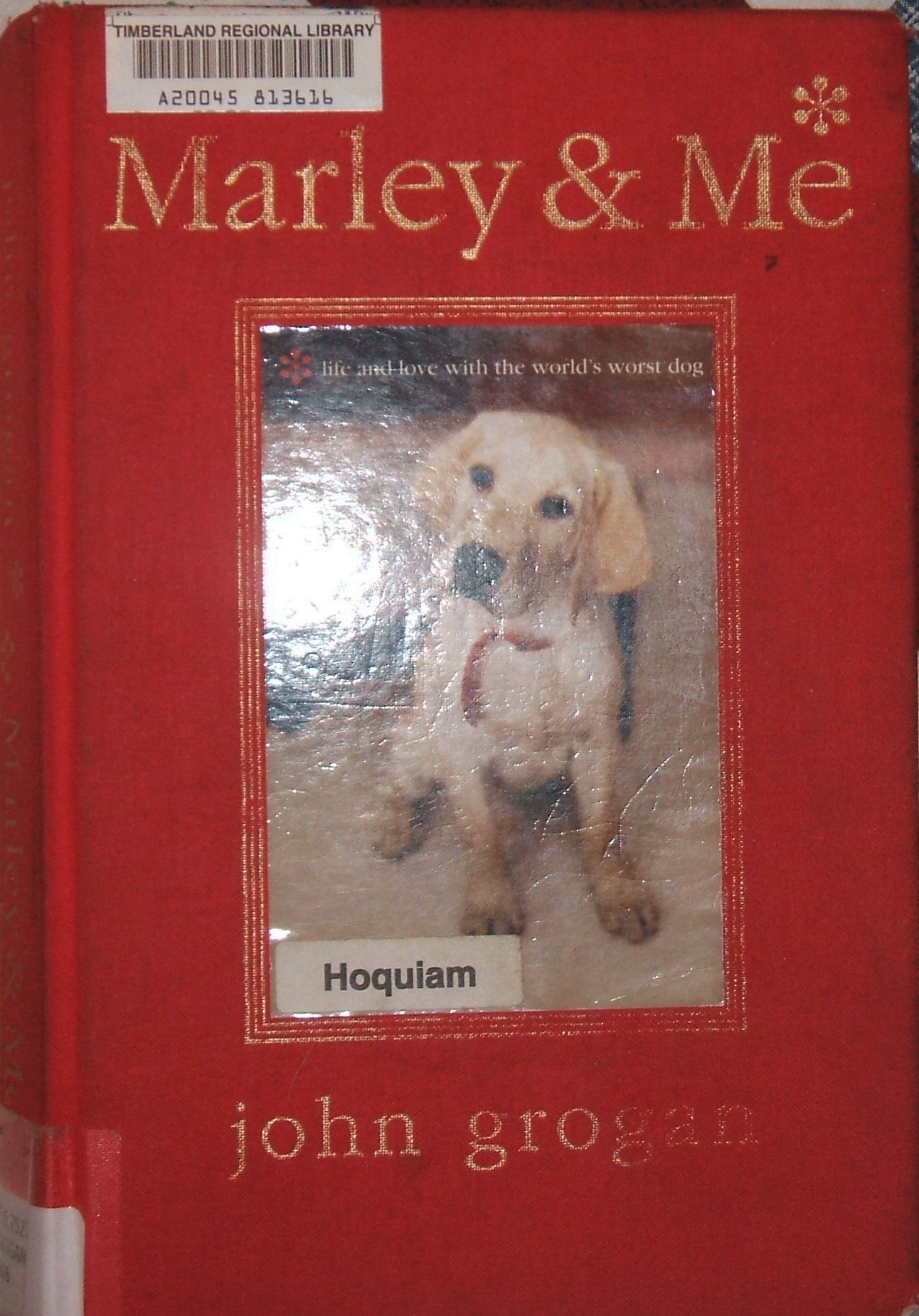
“Marley & Me”: More Than a ‘Dog Story’

Marley & Me: Life and Love with the World’s Worst Dog

By John Grogran

Harper Collins, 2005

ISN: 13: 978-0-06-123822-2

I confess.  I’m a dyed-in-the-Alpo, no-bones-about-it, unabashed, bonafide dog lover, but even feline fans will appreciate John Grogan’s Marley & Me: Life and Love with the World’s Worst Dog.  An eloquent look at a “wondrously neurotic dog” and “what really matters in life,” this engaging, insightful epic recounts the zany escapades of a ninety-seven pound yellow Labrador retriever who “crashed through life with a gusto often associated with natural disasters” and the humans who loved him.

Marley begins when newlyweds John and Jen Grogan move to South Florida and begin budding careers as journalists at competing newspapers.  An adorable “clearance puppy”  turns their lives inside out and upside down for thirteen roaring, soaring, raucous, wonderful years – as only a “loopy” dog can.

A richly textured three-dimensional portrait of family life and love, Marley avoids maudlin sentimentality while offering honest “slice of life” vignettes to which anyone relate.  It’s also wickedly funny.  Catapult-like, this wild ride with “the world’s worst dog” races through mango snacks, gold necklace “dessert,” poodle distractions, drywall destruction, thunder phobias, ejection from obedience school, mishaps at Dog Beach, to loss, disappointment, kids and sleep deprivation, a scream in the night, job changes, moves, and the kind of unwavering loyalty, devotion, and crazy love that’s unique to canines.

Marley & Me is more than a “dog story.”  Grogan’s nimble pacing, pithy observations and quirky chronicling evoke both laugh-out-loud mirth and hand-me-another-tissue sniffles.  Marley makes you want to run, not walk, to the nearest mutt and hug him or her for dear life.

Speaking of which, Grogan’s first-person narrative runs the gamut of “everyday life” emotions: appreciation, apprehension, horror, humiliation, unbridled glee, intense sorrow, exasperation, exhaustion, effervescence and ebullience.  Chapters include And Puppy Makes Three, A Battle of Wills, The Things He Ate,  In the Land of Bocahontas, alfresco Dining, Lightning Strikes, The Big Meadow and Beneath the Cherry Tree.   A special bonus is a reprint of Grogan’s January 6, 2004 column about Marley from the Philadelphia Inquirer, Saying Farewell to a Faithful Pal, that inspired the book (bring Kleenex).

Nuts as Marley is, we get the feeling that the world would be a better place if more humans lived and loved like this crazy yellow dog.  Indeed, Marley and Me leaves no doubt as to why dogs, not cats, are tagged as “man’s best friend.”  By the end of the book you’ll feel like you’ve known the Grogans for years, and that Marley was your dog, too.  (Have I told you about Eve, our mellow yellow Lab? A Marley polar-opposite, Eve is by far and away the smartest member of our family.)

Even cat lovers will get this one.  Four stars (for occasional language, adult themes.)

***

Coming up:

Laughing All the Way: 10 Tips for the Hilarity Highway and a five-part mini-series: Write Away…