
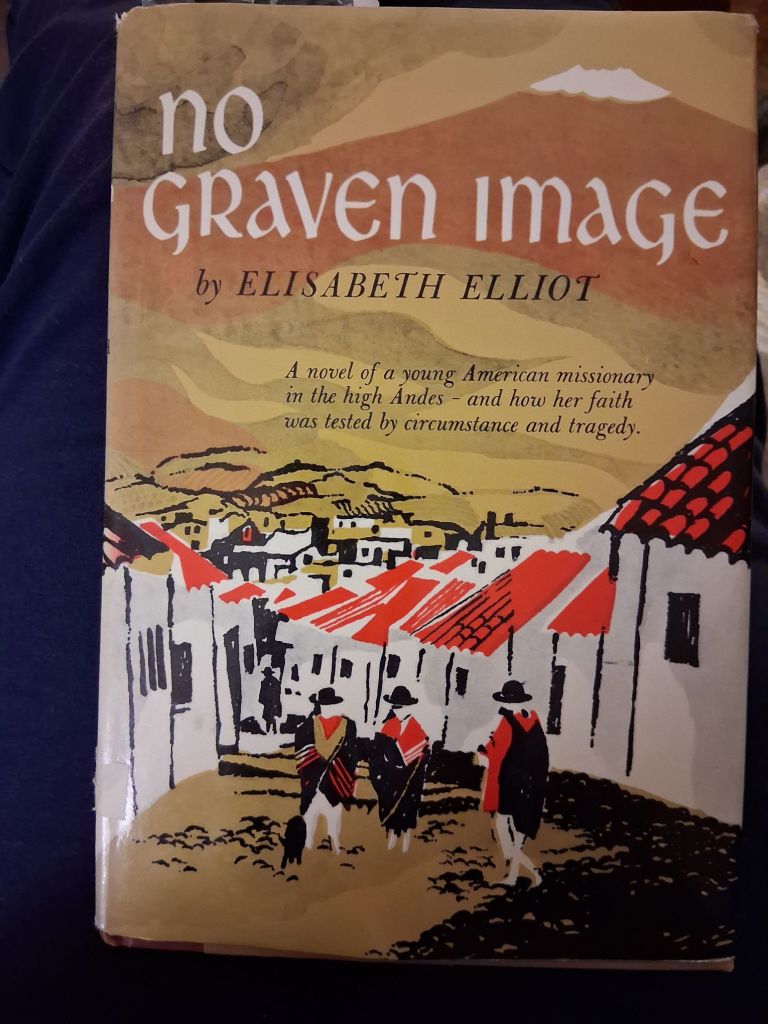
No Graven Image
By Elisabeth Elliot (Harper & Row, 1966)
Genre: Non-Fiction
Pages: 244
Via: Amazon
“Then he isn’t safe?” said Lucy.
“Safe?” said Mr. Beaver. “Don’t you hear what Mrs. Beaver tells you? Who said anything about safe? ’Course he isn’t safe. But he’s good. He’s the King, I tell you.” (Emphasis added.)– C.S. Lewis, The Lion, the Witch and the Wardrobe.
Margaret Sparhawk is a young, idealistic American missionary in this compelling Christian fiction by former missionary and best-selling author Elisabeth Elliot. Margaret travels to Ecuador to reach the Quichua Indians of the Andes Mountains. At first, she feels displaced. But per Matthew 28:19-20, Margaret (“Margarita”) is certain she belongs there. “I am under orders” she says to herself.

Veteran missionaries Ian and Janet McDonald help Margaret settle into a little house in the small mountain village of Indi Urcu, “Hill of the Sun.” Her mission sending agency, Indians for Christ, Inc., is dedicated to reaching the Quichua Indians for Christ.
Margaret is soon puzzling over how to do this. How does she start? What exactly is “missionary work”? How should her typical day look? “I wish that term ‘missionary’ were a little more clearly definable” Margaret muses. “If I had been a missionary teacher or doctor or nurse my goals would have seemed unequivocal.” Now she’s not so sure. “It was strange to find the actual daily doing of missionary work so unspecific, so lacking in direction.”
Plagued by “anxiety and self-criticism,” Margaret also expresses her “genuine gratitude to God for the privilege which I saw was mine.” She scolds herself for “worrying about cold feet, broken lanterns, dust and a lack of closet space.” After all, aren’t these small inconveniences “petty,” compared to her calling of reaching the Quichua for Christ? And what can she report to the folks back home in her next prayer letter?
Margaret sees little progress at first as she struggles to balance doubt and faith. She eventually gains a following and an enhanced reputation for her part in the safe and seemingly miraculous delivery of a breech baby. She’s overjoyed when her prayers for an “informant” seem to be answered when she finds Pedro Chimbu in the marketplace. Pedro agrees to help Margaret with her translation work. His wife, Rosa, is less than thrilled.
Things seem to be going well. Margaret works on her translation of the Bible into the Indian language and befriends Pedro and his family. Then tragedy strikes, shaking Margaret’s entire way of thinking.
Shift
The final pages of this engrossing novel reveal a subtle shift in Margaret. How she sees herself, her “work,” and “her” God. There’s an expansion or spaciousness in Margaret’s heart and mind and soul that didn’t exist previously. When we first meet Margaret, she’s uncertain. Hopeful. Young and idealistic. Dedicated and diligent. She wants to make sure everything she does and says is God’s will. The story ends with Margaret visiting Pedro’s grave as a lone condor soars overhead. It is both haunting and elegiac.

Told in the first person from Margaret’s POV, No Graven Image can be read on multiple different levels (much like Lewis’s The Chronicles of Narnia). NGI can be read as semi-autobiographical. Or as Christian fiction. As a coming-of-age tale. Or perhaps a cautionary tale. All of those are valid. What it can’t be read as is a novel with “strings attached.” By that we mean preconceived ideas and notions about how it should unfold or end. Whether or not it should “teach” some valuable life lesson or impart some vital biblical truth. Cuz if you read NGI expecting happy endings and a neat and tidy conclusion tied up in a bow, you’ve come to the wrong place. Because Elliot writes about what she sees. Not what people want to hear.
The Protagonist
Why did Elliot choose “Margaret Sparhawk” for her protagonist? Interesting name, isn’t it? We did a little digging. A “Sparhawk” or “sparrow hawk” is a small bird of prey, known for its agility and hunting skills. It begs the question: So, what, exactly might Margaret “Sparhawk” be “hunting” or seeking?
Kimber: You probably already guessed that Her Royal Momness has some thoughts on that. So, hang on a min. While you’re ruminating on that “hunting” thing, ruminate on this: What’s a “graven image”? And why did Elliot choose the term for her book title?
The Title
The Second Commandment of the Ten Commandments is, “You shall not make for yourself a graven image” (Exodus 20:4. Basically, a “graven image” is an idol. An imposter. A fake. A creation of human hands – or minds- lacking any authentic divine power.
So why did Elliot choose “No Graven Image” for a title? As titles go, it’s a curious one. Especially for a novel about a young Christian missionary. What was Elliot trying to convey? Just who or what, exactly, is the “graven image” of the title?
The answer is It Depends. Part of the genius of this novel is that it avoids easy answers and pious platitudes. It makes you think. Dig deep. There’s no spoon-feeding here.
At its core, Margaret’s story shows the “god-of-my-plans” as a “graven image.” That image is deconstructed, brick by brick. Clues along the way include:
- “My faith worked best when things worked as I had planned.” (But what if things don’t go as planned?)
- “What can I say to match that kind of success story? What was there to say?”
- “He and the others who had spoken used a language and a distinctive tone that echoed through my mind from a thousand pulpits… I had never thought of these phrases as platitudes, and I did not question what they had to say. Like the primitive tribesman, who, upon hearing a recording about God, was convinced of its truth because it said the same thing each time it was played, I accepted what they told me as true.”
- “Why this need to find meaning at every turn? Why do I struggle to sort out the material and the spiritual, to separate the failures from the successes… Who was I to label things?”
- “The Western compulsion to account for everything struck me now as pompous and at times defensive.”
Other clues are personified in the character of missionary doctor Lynn Anderson. Like an exchange between Dr. Anderson and Margaret regarding the assumption that all missionary efforts will be “successful.” Musing on the needs “all around,” Margaret says, “it seems so hopeless to do anything about it, and then when you hear all these reports (from other missionaries), you’re convinced it’s not hopeless after all.”
Anderson replies, “And suppose, after a few years’ work, you found that it was?”
This isn’t the response Maragaret expects. It’s probably not the response most readers expect. Shaken, Margret protests, “Oh, but it couldn’t be hopeless. You don’t mean that’s what you found?” Anderson clarifies that she was asking a question. “What would happen to your idea of God, for instance, if you found that your work was useless?”
Later, over dinner with a group of missionaries, Anderson muses, “I wonder if it is possible that God might have some excellent reasons, quite outside our imagining, for not doing what we think He ought to do?”
Another missionary, Miss Blake, offers quick, instant answers. But Margaret can’t dismiss Anderson’s question as quickly as Miss Blake can.
Anderson later asks, “Did God ever destroy anything which He Himself had built?” Miss Blake snaps, “Don’t you believe, Dr. Anderson, that we’re here to win souls? Don’t you believe that? What is the missionary task, after all?”
Anderson gently responds, “I am no longer as sure as I once was.”
And neither is Margaret. About twenty pages later Margaret learns that a missionary couple planning to help with her translation efforts is rejected on health grounds. Maragret is shaken and confused. Hadn’t the Gardeners received a clear call from God for missionary service? Hadn’t they been obedient and “thoroughly prayed for”? “How was I to accept a negative answer to so many people’s prayers? I could agree that God’s ways are not our ways, all right. But why do we insist on trying to make them so?”
Then an American photographer arrives to document Margaret’s work with the Quichua. She observes: “Desperately he sought proofs, exhibits. What he had found was clearly not up to his expectations of the work of God. … Harvey had not come to learn but to document what he already assumed; his reception governed his selection of picture subjects. Propaganda, I thought, demands simplification.”
Finally, at Pedro’s grave when all seems lost, Margaret realizes she no longer has to arrange her life in an “orderly succession of projects with realizable goals and demonstrable efforts.” She “cannot designate this activity as ‘useful’ and that one as ‘useless’, for often the categories are reversed and even more often I am at a loss to apply either label.” In the end, she muses, “the work as well as the labeling, is God’s.”
Over time, Margaret gradually realizes she’s created a “mental idol” of what her missionary life and work are supposed to look like. The image she has of God is someone she can relate to as long as he does what she wants, the way she wants. But that “god” is fake. A graven image. When tragedy strikes the image teeters, falls, and shatters. Thereafter, Margaret must rely on God Himself rather than her expectations. Thus, Elliot deftly demonstrates that true faith, like true freedom, rest in God’s character. Margaret puts it this way: “God, if He was merely my accomplice, had betrayed me. If, on the other hand, He was God, He had freed me.”
The Condor
It’s no coincidence that the majestic Andean Condor, the national bird of Ecuador, appears in the final page. It soars high and free above Margaret and the Indian cemetery as Margaret sees her own identity “in its true perspective” for the first time. And we, like Margaret, see that perhaps her “hunt” for God Himself has finally ended.

No Graven Image is Elisabeth Elliot’s first and last work of fiction. A prodigious nonfiction talent, her skill in fiction is likewise formidable. In fact, NGI may be the best Christian fiction you’ve never read. So why did the novel receive such a tepid reception when it was first published in 1966? Perhaps it didn’t resonate because NGI resists the typical “moral tale” expected. It doesn’t follow the predictable “two-pronged” formulaic writing common in Chrisitan publishing: Person turns from God and meets trouble; person turns to God and is blessed. When readers fed on this formulaic diet read a faith-based novel that doesn’t “add up” or fit the equation, they often spit it out. And that’s too bad. Because doing so misses the point.
Ahead of Her Time?
It’s also possible that 1960s evangelicalism wasn’t ready for No Graven Image. Again, Elliot wrote what she saw, not what people wanted to hear. Her audiences of the day wanted uplifting, heartwarming stories about souls won, lives transformed and glorious victories on the mission field. They wanted a “missionary story” to end on a note of triumph. Wrap up with a nice, neat bow. Or at least a glittering “Aha!” moment.
No Graven Image doesn’t do that. Today’s readers may have more of a thirst for the authenticity and ambiguity of this novel. In this regard, Elliot was light years ahead of her time. Thus, modern-day readers are beginning to realize that like C.S. Lewis, Elliot didn’t write about a “tame lion.” She wrote honestly and eloquently about the Lion she saw and knew personally. The Lion who “isn’t safe. But he’s good.”
And that, friends, is a mark of genius.

Our Rating: 5.0
For our reviews on Elisabeth Elliot biographies, see:
A Story That Strengthens: ‘Becoming Elisabeth Elliot’
Flawed and Faith-Filled: The Complex Legacy of Elisabeth Elliot


 Pages & Paws
March 6, 2026 at 12:54 am
Thanks for reviewing an older classic. This is going on my TBR list! Cheers.
Jeff
March 5, 2026 at 7:58 pm
You’re welcome Jeff. Enjoy!