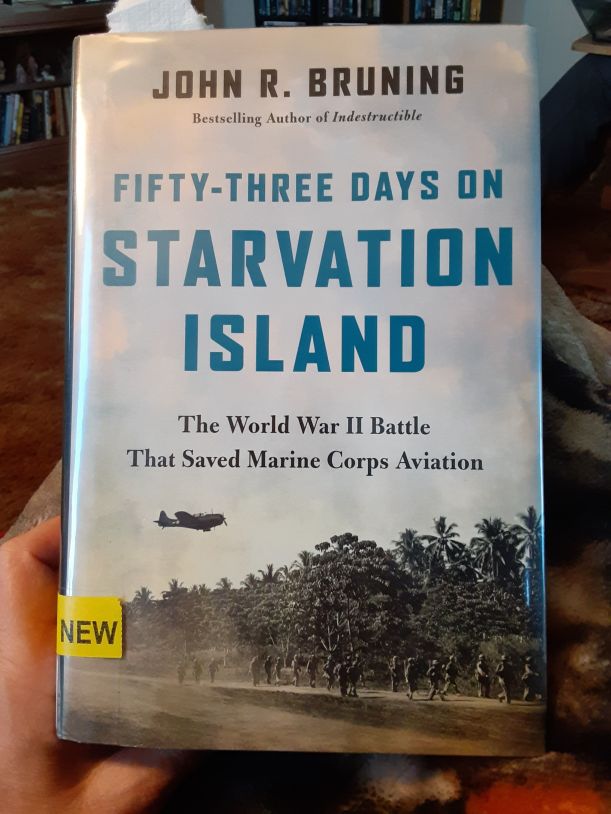
Fifty-Three Days on Starvation Island
The World War II Battle That Saved Marine Corps Aviation
By John Bruning
Via’ Library
Genre: Narrative Non-Fiction/Military History
Pages: 436 + Epilogue, Final Note, Their Legacy, Appendix, Bibliographic Essay, Notes, and Index
Note: We’re posting this review today because November 10 is a very important day in our household. Dad was a Marine. And November 10 is the Marine Corps Birthday. In honor of The Few. The Proud, we thought we’d look back at a historic battle in a long line of historic USMC battles via this book. From the Halls of Montezuma, to the Shores of Tripoli…
Hi, Dad!
“Life was reduced to a broken record, stuck on a single measure: patrol, alert duty, get shelled, try to sleep in a hole.”
Forget Tom Cruise and Top Gun. The Marine Corps aviators of Guadalcanal were The Real Deal, as so eloquently and articulately conveyed in this gripping narrative non-fiction tome by historian John R. Bruning.
“But in this moment, the darkest hours of marine aviation, the trough between the swells rising around them was deep. And there were no other options. For the sake of the country, these half-trained men would go to war.”
Vital
Guadalcanal was vital to both U.S. and Japanese forces in WW II. By seizing Henderson Field, a strategic airfield on the island, the U.S. stopped Japanese efforts to disrupt supply routes to Australia and New Zealand. The invasion ignited a ferocious struggle marked by seven major naval battles, numerous clashes ashore, and almost continuous air combat. Securing Guadalcanal was a crucial step in defeating the Japanese in the Pacific theater.
It also came at a tremendous cost.
“’Men, your job is to buy time with your lives until the Navy and Corps can get more planes and men to Guadalcanal.’”
Meticulously researched and thoroughly documented, Fifty-Three Days on Starvation Island is the true story about that price tag and those who paid it.
“In the ready rooms, the young Americans scooped up their flight gear, slung their parachutes over one shoulder, and headed for the flight deck and their waiting aircraft. It was gut-check time, the first of many to come in the fifty-three days ahead.”
Do-or-Die
Fifty-Three Days chronicles the do-or-die mission in which thinly stretched “mud Marines” on Guadalcanal had to hold the island against a furious onslaught by the Japanese. The Marines would have to hold the line until America could catch up with its own offensive and get the needed planes and pilots to where the fighting raged.
“Altogether, the Marines would go into Guadalcanal with eleven SBD Dauntlessness and nineteen F4F Wildcats. They would be facing the pride of the Imperial Japanese Navy and hundreds of aircraft based at Rabaul. Until help arrived, they would be outnumbered and outgunned. But the Marines already on Guadalcanal depended on the arrival of these reinforcements for their very survival.”
I know. I’m adorable.
By a Thread
Thus, the desperate do-or-die mission hung by a thread on the clunky silver wings of aging Douglas Dauntless dive-bombers (SBDs) and Grumman Wildcats, and the young pilots who flew them. Cuz without air cover, the mud Marines on the ground would be wiped out. Fast.
“It became a titanic test of national will. Could the United States, struggling to create a globally deployable military, defeat the blooded veterans of Imperial Japan? Could a nation so isolationist rise to the occasion and overcome its own inexperience in offensive amphibious warfare to prevail after so many mistakes?”
The story is told in semi-flashback fashion. The early pages begin in November 1942. We’re introduced to three Guadalcanal veterans: John L. Smith, Richard Mangrum, and Marion Carl. They’re Marine aviators who’ve just arrived home in the States after being relieved from Guadalcanal. They’re thrown into a ”hero tour.” Their backstories are filled in later, as are the lives of some of the other Guadalcanal vets.
We follow the trio to Ewa Field on Oahu in Part Two. Then aboard the USS Long Island to the Fiji Island, the New Hebrides Island and the Solomon Islands and finally, Guadalcanal (August 1942). Some readers may find this portion of the book a bit slow. Be patient. The author is building backstories and fleshing out key personalities. So hang with it.
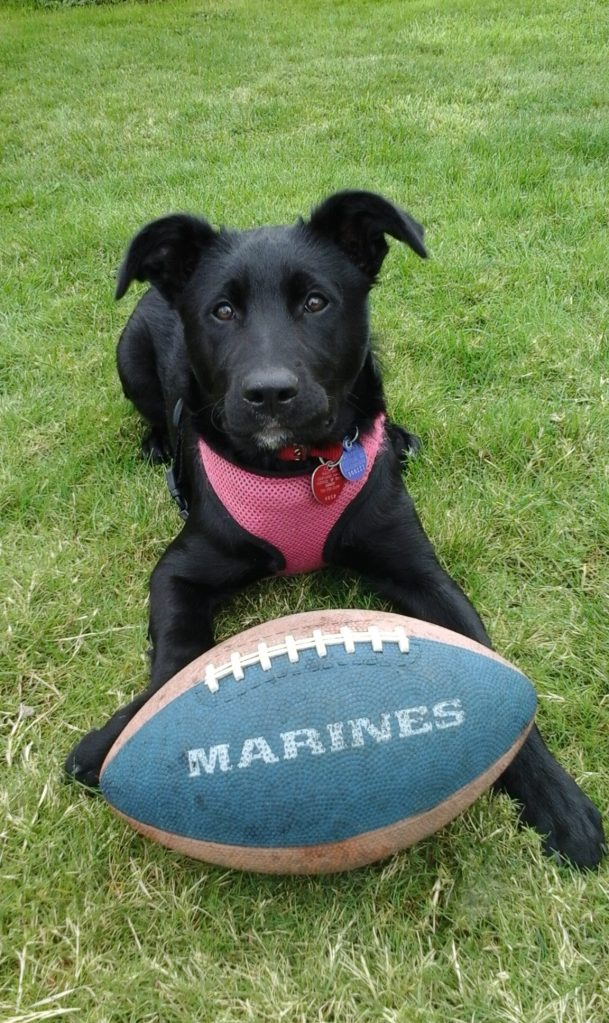
‘Oo-rah!’
We get to Henderson Field on Guadalcanal on page 162. The chapter heading is Thrown to the Wolves. That’s putting it mildly.
More…
There’s a runway cratered by Japanese bombs and pockmarked by Zero strafing runs. “Torrents of gunfire” and “roiling mushroom clouds of flame” as Japanese shells rain down on Henderson Field and her grim Marine defenders. Starvation. Desperation. Suffocating heart and humidity. Clouds of mosquitoes. Endless seas of mud. Disease. Fungal infections. Being pounded by Japanese bombing and strafing runs constantly. Severe shortages of food, shelter, water, fuel, ammo, spare parts, meds, and manpower.
“Men flew with malaria, fevers of over 101 degrees. Others battled dysentery or gastroenteritis, unable to hold anything down. Dehydrated, sleep-deprived, their skin now pockmarked with open sores the Marines dubbed jungle rot, all they could do was hang on, keep flying the missions demanded of them, and pray for relief soon.”
But it’s not just an absorbing narrative of the ferocious battle over Henderson Field. Bruning interweaves the gripping narrative of Marion Carol’s hair-raising, harrowing bid to get to his unit at Henderson after he’s shot down behind enemy lines.
Smack Dab in the Middle
Kindly note that Fifty-Three Daysisn’t a high-level view of the battle seen while safely orbiting the stratosphere and sipping champagne and nibbling caviar from a gazillion feet off the deck. Nope. The author takes you smack dab into the middle of one of the fiercest battles of the war in the Pacific.
You get to know pilots and crew like they’re your next door neighbors. You can almost hear the bombs exploding on Henderson Field, shrapnel flying everywhere. Hear the whine of the swift and agile Japanese Zeroes attacking. Taste the omnipresent mud and weevil-ridden rice. Feel the beyond-exhausted fatigue as outmanned, outgunned, and outnumbered air and ground crews fight a desperate pitched battle against one furious Japanese onslaught after another.
“Like a boxer in the tenth round on his feet from sheer tenacious will alone, the Americans were punch-drunk, traumatized, sick, half-starved, and grief racked over the brothers whom they had seen killed.
But the Marines were still in the fight.”
The Cost
How they won and the terrible cost of victory is duly recorded in this thoroughly captivating non-fiction read.
Trying to adequately summarize this book is like trying to measure the Atlantic Ocean with a teaspoon. It’s just too big. There’s too much going on. It’s hair-raising. Mind-numbing. Jaw-dropping. Freckle-rattling.
Not a Coffee Table Book
Kindly also note that Fifty-Three Days is NOT a coffee table kinda book. Nopers. Better strap into your helmet and flak jacket. Cuz this is one tough, exhausting read. It’s also meticulously researched. Very detailed. And very thorough. In fact, it’s one of the most extraordinary stories of sheer grit and determination in the face of seemingly insurmountable obstacles and overwhelming odds I’ve ever read.
“Average Americans, with minimal training and experience achieved that monumental task (seizing the initiative from Japan) and bent the tide of history to their will.”
Awe, Reverence
Indeed, there’s a reason “Guadalcanal” is uttered with awe and reverence in knowledgeable circles. Why this pivotal battle in the early, desperate days of WWII is legend among The Few. The Proud. Why names like John L. Smith, Richard Mangrum, and Marion Carl should never be forgotten. Especially on this auspicious birthday. Oo-rah!
Finally, Fifty-Three Days on Starvation Island is one of the most riveting and remarkable tales of WWII heroism I’ve ever read. You should, too. Now would be good.

 Pages & Paws
November 10, 2024 at 1:14 pm
I agree, we all should. Thanks for the reminder. And please give my thanks to your other half for his service. Hadn’t known you’d landed a leatherneck!
November 10, 2024 at 4:46 pm
Thanks and will do!