
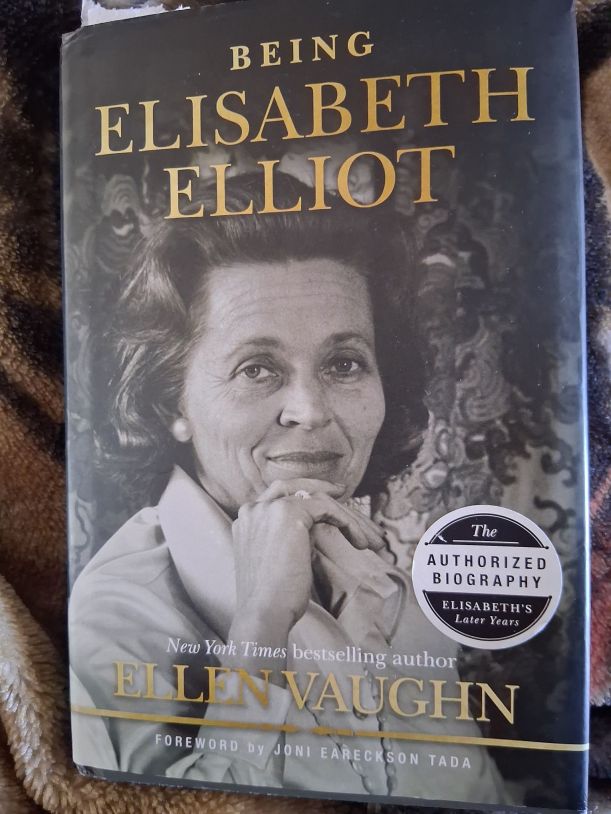
Being Elisabeth Elliot: The Authorized Biography of Elisabeth’s Later Years
By Ellen Vaughn (B&H Publishing Group, 2023)
Genre: Non-Fiction
Pages: 278
Visa: Library book sale
Who was she?
This question lies at the heart of one of the finest biographies we’ve ever read, Being Elisabeth Elliot. The second in a two-part biographical series on the late missionary and Christian thought leader, Being picks up where Becoming Elisabeth Elliot leaves off. (Here’s our review of the latter: A Story That Strengthens: ‘Becoming Elisabeth Elliot.’)
Elisabeth Elliot has long held a top slot in our list of All-Time Favorite Authors. Her life was mixed with “good, bad, glory, pain, tedium, hope, and despair.” Elisabeth’s first husband, Jim Elliot, was martyred in Ecuador along with four other American missionaries in the 1950s. Thereafter, Elisabeth’s life of obedience, timeless teachings, and best-selling books influenced both believers and seekers of the Christian faith for over fifty years.
“Some things may legitimately be alleviated, others necessarily endured. May God give us wisdom to know the difference.” – Unattributed, underlined entry in Elisabeth Elliot’s well-worn notebook of favorite quotes.)
Puzzling, Inspiring
So, what shaped this prolific, sturdy author’s life? Based on meticulous research and a voluminous amount of primary source material that includes Elisabeth’s “sometimes too-frank journals” and letters, New York Times bestselling author Ellen Vaughn explores these questions and more in this thoroughly engaging biography of one of the foremost Christian thinkers of our time. Expertly written and nimbly paced, the life story that emerges is one that’s as puzzling and perplexing as it is amazing and inspiring.
But we’re getting ahead of ourselves. First:
Format
Being Elisabeth Elliot is told in three parts:
- Part One is Bedrock. It’s two chapters.
- Part Two is Being. It’s 35 chapters.
- Part Three, Believing, is two chapters. It includes chapter 38, Who Was She? And the Epilogue: The Truth Is Love.
No Halos
This biography is straight-forward. Clear-eyed. There’s no “Saint Elisabeth” perched on a pedestal here. No halo circles Elisabeth’s head. The text is respectful. It’s also honest. The author skillfully avoids a cryogenic Elisabeth Elliot, frozen in time. Instead, Vaughn shows us how Elisabeth grew, developed, and learned. How Elisabeth isn’t the same person in her fifties as she was in her twenties. How she led a public life but was an intensely private person.
Sole Work
We learn that while Elisabeth Elliot is well-known for her non-fiction books, she yearned to write fiction. But she penned just one fiction work: No Graven Image (Harper & Row, 1966.) The response was tepid. NGI “caused more consternation than contemplation among Christian readers, and secular readers had no interest in reading a story about the spiritual awakening of a young missionary trapped in the constraints of her evangelical subculture.” Elliot refused to give American audiences the “sweetness and light” missionary stories they wanted to hear. In fact, Elliot expressed disdain at Christian publishing for making stories “neat and tidy.” Instead, she chose to be honest about her experiences and observations on the mission field. Elliot wrote what she saw, not what people wanted to hear. So NGI’s lukewarm reception – to put it mildly – hurt her deeply. It was her sole work of fiction. (We ordered our own copy of NGI. We’ll keep you posted.)
Meanwhile, much of Elliot’s life story circles around her friends, family, and marriages. She has a house in New Hampshire. A voracious reader and lifelong learner, Elisabeth reads widely and has a special affinity for Isak Dinesen and Corrie ten Boom. Elisabeth hikes, swims, picnics, and delights in nature. Hosts dinner parties and numerous guests. She has a great sense of humor and often kept her family in stitches with her hilarious comedy monologues. With a keen eye and ear for truth, Elisabeth agonizes over what to write and how to write it. She’s a meticulous housekeeper with exacting standards. Elisabeth delights in her daughter, Valerie, and maintains a voluminous correspondence with family members. She re-marries. Twice.
After the death of Elisabeth’s first two husbands, Jim Elliot (martyred in Ecuador in 1956) and Addison Letich (cancer in 1973), Elisabeth married a third time. At nearly four decades, her marriage with Lars Gren was the longest. It was also the most difficult and unhappy. (Kimber: More on this in a min, okay? So kindly keep your shirt on, Cookie.)
Centerpiece
The “emotional centerpiece” of Being is its “account of Addison Leitch’s battle with cancer and his subsequent death.” It is harrowing and heart-breaking. “Her second widowhood was an ironic season of pain, loss, distraction, yearning, and seeking God’s will,” writes Vaughn. It was also “a year of primal, almost unbearable loneliness.”
Third Marriage
Elisabeth marries Lars Gren four years after “Add” dies, not yet aware of Gren’s “rage and control issues.” Her third husband is described as “angry”, “furious,” “manipulative” and “abusive.” In marrying the “controlling” Gren, writes Vaughn, Elisabeth “exchange(d)… freedom for security. She became a person whose highest value was the desire to feel secure.” Continues Vaughn, “within nine days (of her wedding to Gren, Elisabeth) told her closest friends and family members that she had made the biggest mistake of her life.”
Elisabeth Elliot chose to be buried next to Addison Leitch, “the love of her life.”
Beyond key life events and relationships ably chronicled in Being, we meet an Elisabeth who is not only a formidable intellect, but who’s also a woman capable of deep devotion, fierce loyalty, grand humor, and great sacrifice. She plumbs divine mysteries deeply – perhaps more deeply than any other contemporary author we’ve ever read, except perhaps C.S. Lewis, John Eldredge, or Max Lucado.
In these pages we also see an Elisabeth who’s both obstinate and malleable. Severe. Soft. Faithful. Fearful. Curious. Close-minded. Inspiring. Intense. Bewildering. Astonishing. Amazing. Confounding. Taciturn. Her natural reserve is frequently misinterpreted as a lack of warmth. But Elisabeth also had an enormous capacity to love.
“Well aware of the cracks in her own pot,” Elisabeth Elliot is complicated.
Thus, Being Elisabeth Elliot isn’t a mere re-telling of life events or experiences. It’s a deep dive into the heart, soul and mind of one of the foremost Christian thinkers and authors of our time. Superbly written, Being offers a multi-faceted, multi-layered look at the life of a remarkable woman who thought deeply, wrote profoundly, loved passionately, and wrestled endlessly with the inscrutable mysteries of God. Finally, Elisabeth’s single great passion was not Jim Elliot nor Addison Leitch, but her desire to know the God who loved her with an everlasting love.
Indeed, Being Elisabeth Elliot is in a class by itself. Like the Book of Job. So:
“As I have emphasized repeatedly in these books about Elisabeth Elliot, the stories of Christ-followers on this broken planet do not all end with a victorious, triumphal flourish from which read may draw a tidy syllabus of life lessons,” writes Vaugh. “The questions for ardent Elisabeth Elliot fans has never been, ‘What would Elisabeth do?’ or how to ‘be like her.’ It is, as for all of us, that we seek to be like Jesus, and take both comfort and warning from the stories of His flawed friends who have gone before us.”
Elisabeth Elliot was one of those “flawed friends.” Enigmatic to the end, she was not a “marble effigy” but a “flesh-and-blood woman with strengths and weaknesses, like us all.” In other words, Elisabeth Elliot was human.
How refreshing.
We’ve read just about everything Elliot ever wrote. We’ve read both Vaughn biographies. The “who was she?” question remains as elusive and enigmatic as Elisabeth Elliot herself. Maybe that’s the whole point. In the end, readers are left to draw their own conclusions.
Again, Being Elisabeth Elliot is one of the finest biographies we’ve ever read. So if you’re looking for a fluffy, frothy biography of the cotton candy variety, keep looking. This isn’t it. But if you‘re after a candid, compelling read that inspires and invigorates and isn’t afraid of tough questions, grab a copy of Being Elisabeth Elliiot.

Our Rating: 4.00
We wanted to give this book a higher rating. Unfortunately, the manner in which the author inserts her own voice into a “biography” turned us off in places. Ditto how she pretty much skips over about 40 years of Elliot’s later life. The book winds down abruptly with Elliot’s marriage to Gren. Also, repeated typos – dropped commas and periods, open parens, improper use of capitals and quotation marks, etc. – precluded a higher score.
 Pages & Paws
February 19, 2026 at 7:51 pm
I tried to leave a comment and WordPress would not post it. I just watched a series of lectures Elizabeth Elliot did about suffering, but I haven’t read the book. She lived an amazing life.
February 20, 2026 at 8:28 am
Absolutely!