
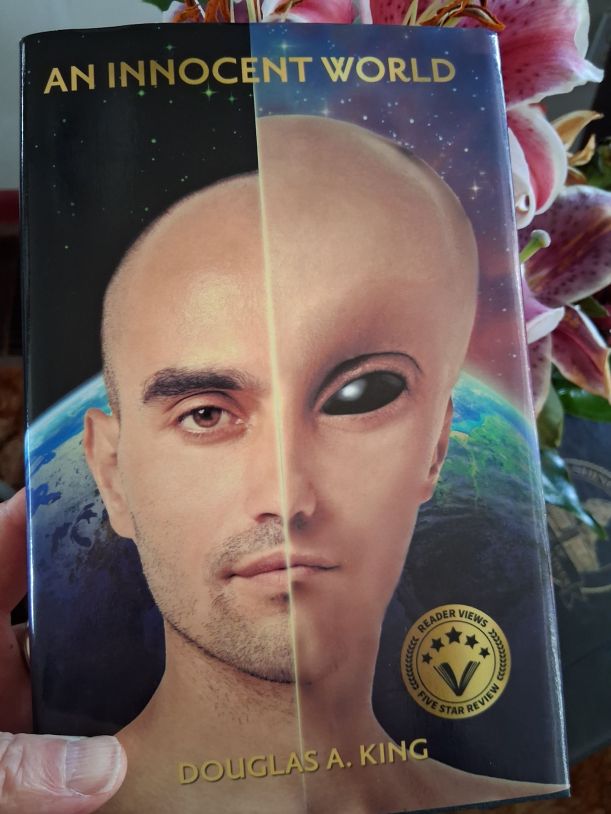
An Innocent World
By Douglas A. King
Pages: 166
Genre: No idea
Via: Author Request
We were gonna write an uber-detailed book review complete with quotes, citations, charts, graphs, maps, popcorn, dancing bears and a floor show. Then we came back to earth. With better things to do. Like watch paint peel.
So forget the floor show. Here are some bare-bones basics:
The Basic Plot (if you can call it that):
What would our world be like if Adam and Eve had NOT eaten the fruit of the Tree of the Knowledge of Good and Evil? And it all began with answering a question that has been literally staring us in the face for the past 3,000 Why was the Tree of Life, the Tree that gives immortal life, in the Garden of Eden, if Adam and Eve were already immortal?
Using logic, Douglas A. King has envisioned a world that is so different from our own that the inhabitants don’t even look like us; they look like the classic space alien, but immortal, where no one harms anyone. This is a world we should all aspire to.
What Ifs?
This book is predicated on a series of What Ifs? Like:
- What if the moon is made of green cheese?
- What if it’s made of cheddar?
- What if it’s made of Colby, Edam, Emmental, Gouda, Gruyere, or Jarlsberg? How ‘bout Mascarpone, Neufchatel, or Brie? Wait.
- What if the moon is just a figment of your imagination?
Okay. Forget the moon. What if you could become a space alien and live in a perfect world?
The Problem
The problem with the green cheese moon and other nonsensical What Ifs is that they’re … nonsensical. They also detract and distract from what’s tried, tested, and true. Like this book. It’s all over the place. Winds up lookin’ like:
Move the Camel
So you shouldn’t be surprised to hear that we don’t recommend this book. Like. At. All. Some of the issues with this book include: 1) The cover art. Really? 2) Pacing. The text moves with the alacrity of a three-toed sloth. We’re talking industrial strength No Doze needed here. 3) Style. It’s pedantic, ponderous, and as dull as a blunt spoon. We’ve seen slugs move faster than this thing. Yawn. 4) It can’t seem to decide what it wants to be when it grows up. Is it fiction on non? Speculative fiction? Fantasy? A sociological survey? A political rant? Sermon? A bad case of dandruff?
All of the above? It’s up for grabs.
Another problem we had with this book is that the What Ifs are silly to the point of absurd. A case in point is the chapter on Population. Soaked in bizarre predictions and highly questionable projections supposedly related to the “be fruitful and multiply” imperative of Genesis 1:28, this chapter misses the whole point of the biblical passage. That’s not unusual. Can’t see the forest for the trees happens a lot in this book. (Hint: in Genesis, it’s not about numbers or years. Hello?) Teetering on the rim edge of incredulity and incoherent more often than not, this book folds like a cheap suit when under any serious scrutiny. (Newsflash: The Bible doesn’t end with Genesis. Hello again.)
Oh, and about that “using logic” thing? Well:
Now. This blog isn’t a Bible study. It isn’t a course in Theology or Biblical Foundations 101. But since An Innocent World claims to be “Bible-based,” we thought we’d take a look at that claim. Conclusion: It’s not. Here’s why (the short version):
The central theme of the Bible isn’t two Trees or their fruit. Nope. The “golden thread” or central theme of both the Old and New Testaments is the person and work of Jesus Christ. Specifically, it’s about God’s gracious salvation through Jesus of Nazareth, for His glory. This theme is present throughout the entire Bible, with the Old Testament foreshadowing and preparing the way for Jesus the Messiah, and the New Testament revealing and expounding on His identity and work.
Here’s more:
- Jesus as the unifying force: The Bible, with its 66 books, finds its unity and coherence through Jesus Christ. Second member of the Triune God, He is the “life-blood” and “pulse” of the entire narrative.
- Jesus as the point of interpretation: Jesus is the central point for understanding and applying the Scriptures.
- God’s love and salvation: The Bible tells the story of God’s love for humanity, His creation of the world, and His plan for redemption through Jesus Christ.
- The restoration of all things: A key theme is the ultimate restoration of all things in Christ, including the universe and God’s people.
- Sub-themes within the central theme: Justice, peace, redemption, and salvation are also significant sub-themes that are intertwined with the central theme of Jesus Christ.
Also, conspicuous by its absence in An Innocent World is the biblical concept of grace. We’re talkin’ 100% MIA here. That kinda matters.
Again, An Innocent World is built on highly questionable hypotheticals and endless What Ifs? The book claims to deliver a look at “what our world would be like if Adam and Eve had NOT eaten the fruit of the Tree of the Knowledge of Good and Evil” and uses “deductive logic… to explore this world; so the truths that are revealed can be taken to the bank.”
Anybody got a blind camel?
The Salient Question
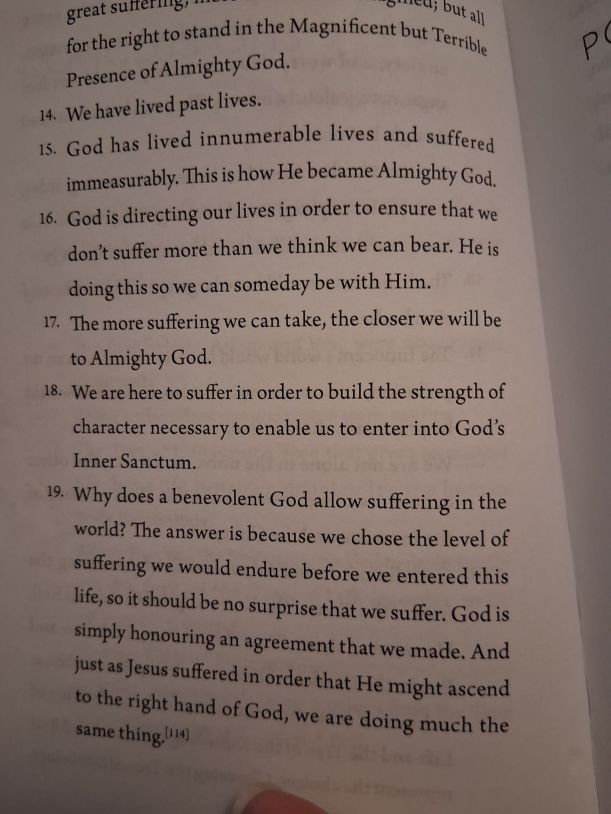
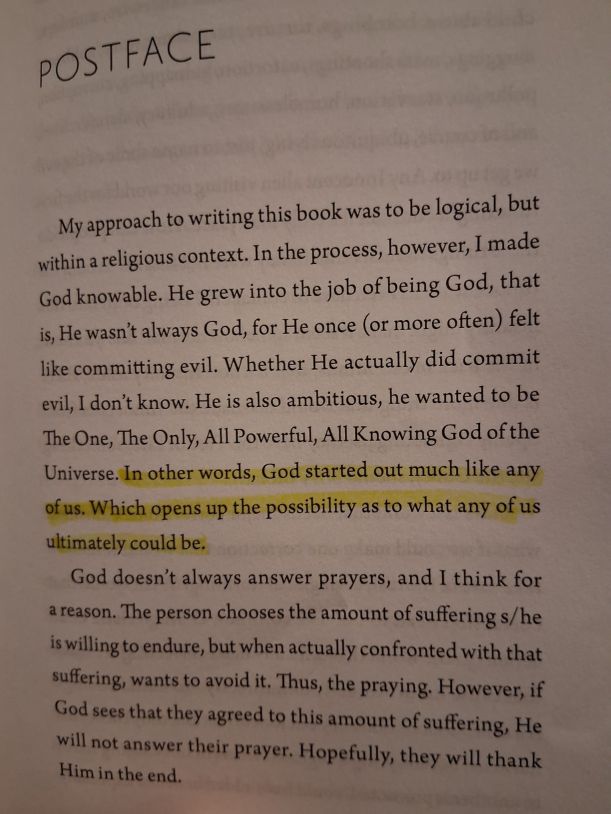
Because the quote above is a pretty lofty claim. It’s also nonsense. Using logic, we deduce that a flawed, shaky foundation results in a flawed, shaky edifice. The kind that collapses in a stiff breeze. Because An Innocent World fails to deliver anything tried, tested, true – or bankable. See the partial list below. From the book’s Conclusions and Postface:
A Primer
So An Innocent World is basically a primer on Hinduism and Buddhism. All while tap-dancing around The Most Salient Question Of All Time. The one Jesus of Nazareth puts to Simon Peter in Matthew 16:15-17:
Who do you say I am?
Meanwhile, tossing a few cherry-picked Bible verses into a blender along with reincarnation, Buddhism, Communism, Chernobyl, space aliens, GMOs, drug and alcohol use, the Quran, NAFTA, Hinduism, and a cast of thousands does not a “Bible-based” book make. Ditto the occasional reference to “Almighty God” or “Jesus” (Which “Jesus”? That kinda matters.)
What emerges is a flimsy and fragmented frappe of convoluted assumptions, presumptions and prognostications that make Geraldo Rivera’s Al Capone’s vaults look smart. So between mondo bizzarro flights of fancy and natterings in Neverland, the text packs the punch of stale kale. With a side of green cheese. (We could go on. But you get the idea.)
There. Just saved you about 160 pages of the most convoluted and contorted pages we’ve ever read. You’re welcome.

Our Rating: 0
Better Books:
The Problem of Pain – C.S. Lewis
For Those Who Hurt – Charles R. Swindoll
These Strange Ashes, A Path Through Suffering – Elisabeth Elliot
Job: Trusting God in Suffering – John MacArthur
Pretty much anything by John Eldredge.
 Pages & Paws