

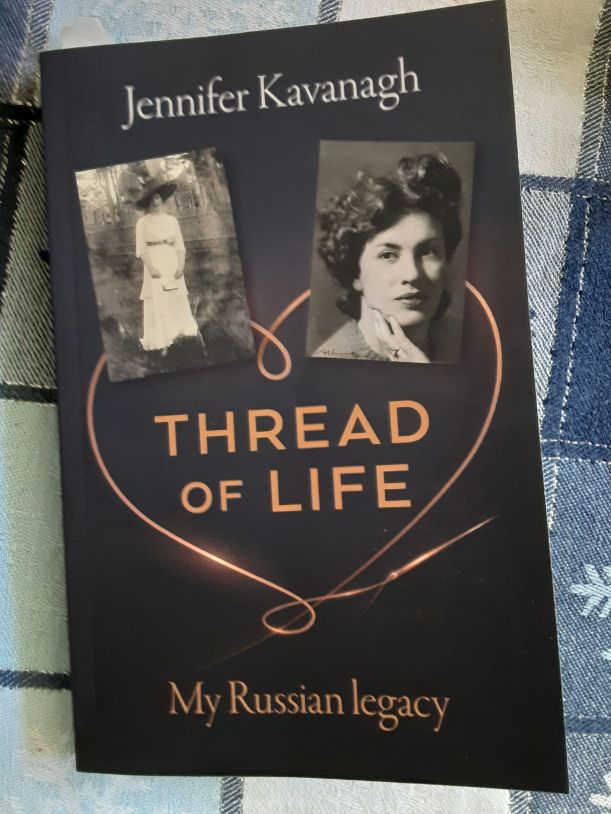
Thread of Life: My Russian Legacy
By Jennifer Kavanaugh (CollectiveInk, 2025)
Genre: Non-fiction/Memoir
Pages: 153 + Chronology and For Further Reading
Via: Author/Publicity Request
Note: We received a complimentary copy of this book in exchange for an honest review.
“This is a story of contrasts: the beauty of St. Petersburg and the brutality which took place within its walls; the gentle beauty of Dora and the atrocity of her treatment. A story that gives glimpses of the paradoxes of the human spirit: the ugliness and beauty of which humanity is capable…”
Thread of Life looks at the 20th century through the lives of three Jewish women. At its heart is Dora, a romantic and tragic figure, a concert pianist born in Riga, Latvia. She lived in St Petersburg and was killed in the Riga Holocaust. Her daughter is Genia. Born in 1915 in St. Petersburg, Genia lived in many places around the world before dying in England at the age of 102. It’s also about the author and her life and perspectives.
A thoughtful weft of memory, history, love, loss, and learning, this memoir includes insights from the author in which she shares her moments of discovery while addressing themes of Russia, Jewishness, motherhood, music, home, and language, as well as the vagaries of memory.
Two Parts
This memoir unfolds in two parts. Part I: Dora and Genia is a chronology. It traces the lives of the author’s mother and grandmother within specific dates and locations. These include St. Petersburg (1915-20), Riga (1920-22), Switzerland (1922-35), Egypt (1935 – 45), Riga (1941 – Dora), Paris,(1955), and England (1945 – 23017). The narrative is crisp, succinct, And brisk.
Part II Threads: The Legacy tells of impact the author’s mother and grandmother had on her life and worldview as she explores her Russian legacy and Jewish background. We found Part I the more readable and engaging portion of this memoir. More on that in a minute.
If I’ve not felt particularly Jewish, the same could be said to be true of my relationship with my Russian heritage.
Mixed Reaction
We had a mixed reaction to this book. It’s beautifully written in elegant prose that’s alternately lyrical, muscular, and profoundly poignant. It also asks some pointed questions. But we also felt like portions of Part II were redundant and didn’t add much. So, it winds up being somewhat tiresome and overlong. So we found it a mixed bag.
Turns in Part Two
The books takes a decided turn in Part II. Instead of following a specific chronology of events through historic events and experiences, the author weighs in on a variety of topics and emotions. The life “threads” she weaves in her tapestry of experience and events include the why of antisemitism, homelessness in London and her “nomadic impulse.” Also, music, censorship, creativity, language and literature, history, and the “ancestral thread.”
The term ‘antisemitism’ may have only been coined in 1879, but the fact of it is it has existed for centuries, and all over the world. Why? Why, over all those years, in so many countries, have the Jews been made the object of exclusion and hatred on such a vast scale? Why have individuals, families, a whole people, been subjected to such persistent vilification?
Missed Opps
The question(s) isn’t really fully answered, although readers are left to draw their own conclusions. And that’s too bad. Because it’s ripe for a lot more ink and this book seems like a perfect segue to address it further. This seems like a missed opportunity. Why a deeper dive into antisemitism is not developed further is baffling, especially in light of the events of October 7, 2023 and the current situation in the Middle East. Russia’s invasion into Ukraine is noted.
Thus, this is essentially a nice essay about one woman’s family history and background and an explanation of who she became and why. But it’s pretty thin on transcendent themes or touching on the human condition in a manner that will likely connect with a wide audience. That missed opportunity thing again. As in, ho-hum.
We also had some issues with formatting. Chapters aren’t numbered. So, you can’t say. “In chapter six…”, etc. Also, the way Part II kept retracing and/or referring back to events or people in Part I gave us whiplash after awhile.
Threads of Life has its moments. In places it’s as brilliant and bold as a lightning-lit night sky. In others it’s as dull as dishwater. It just didn’t grab us. If we’re yawning between pages or looking at the clock at the end of every chapter, that’s not a good sign. But you might want to give it a look-see if you have the time.

 Pages & Paws