

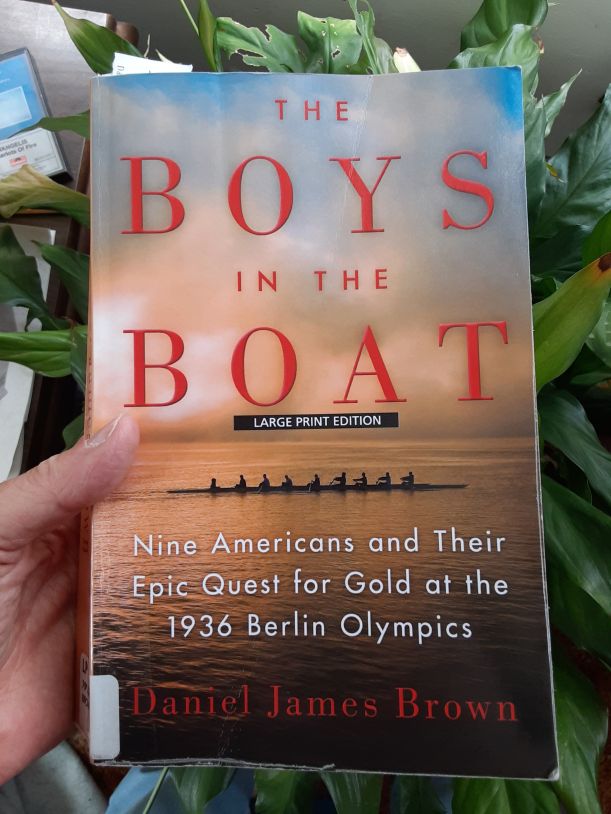
The Boys in the Boat
Nine Americans and Their Epic Quest for Gold at the 1936 Berlin Olympics
By Daniel James Brown (Blue Bear Endeavor, Large Perint Press, 2013)
Via: Library
Genre: Narrative Non-Fiction
Pages (large print): 684 + B&W photos and about 50 pages of Notes)
“They weren’t just nine guys in a boat; they were a crew.”
Two unassuming signs announce the entrance and egress to the City of Sequim in Clallam County, Washington State. Perched on the shoulder of U.S. 101, they’re almost impossible to read as you drive by at 60-ish mph. But Mom caught ‘em. Or at least, a few words: Welcome to Squim, Home of Olympic Champions…” Or maybe it was “Gold Medalists…”
We went by too fast to read the rest. But we’re willing to bet the name Joe Rantz, one of the boys in the boat, is on it.
“The boys who had made it this far were rugged and optimistic in a way that seemed emblematic of their western roots.”
Joe’s mom died when he was a toddler. His father quickly remarries. To the Wicked Witch of the West. Thula resents Joe. He’s chucked outside their Spokane house at her insistence and winds up living in the schoolhouse in exchange for chopping wood and doing other chores.
With jobs scarce in Eastern Washington, the Rantzes and Joe move west to Sequim.
But one afternoon Joe comes home from school to find the family jalopy loaded to the gills and all his half-siblings inside. Dad announces that the fam is heading to Seattle to look for work. Joe must stay behind. Cuz… Thula.
Abandoned in Sequim by his father and stepmom at age 15, Joe Rantz was left to fend for himself in the throes of the Great Depression. Joe fishes, hunts and forages for food. He fells timber. Digs irrigation ditches. Paves roads, chops wood, removes tree stumps and bales hay. He works any odd job he can to survive. Joe basically works his tail off while staying in school and getting good grades.
How the shy, reserved, and reticent young man becomes part of a championship rowing team for the University of Washington (Go Huskies!) and stuns the Nazis at the 1936 Berlin Olympic Games rounds out the balance of this remarkable true story. It’s one of the finest, most inspiring sports stories we’ve ever read.
“You had to master your opponent mentally. When the critical moment in a close race was upon you, you had to know something he did not – that down in your core you still had something in reserve, something you had not yet shown…”
More
Kindly note that The Boys in the Boat isn’t just about strength and power or eight-man crewing. It’s about a lot more. Like the tremendous mental discipline and teamwork crewing demands, perhaps unmatched in any other team sport. It’s also about developing “the rare balance of ego and humility that great oarsmen somehow always manage to have…”
“As the final and most prestigious event of the day – the eight-oared race – drew near, the crowd began to grow noisy once more. This was the rowing event that nations boasted about more than any other, the ultimate test of young men’s ability to pull together, the greatest display of power, grace, and guts on water.”
They’re also “camber” and “swing.” And we’re not talking dance steps. Additionally, the narrative features detailed explanations of the physiology of rowing and master boat builder George Pocock’s expert construction of his sleek, high-performance boats, made from carefully selected Northwest woods. Fascinating!
Percolating or juxtaposed throughout the story are snippets of Josef Goebbels’ ferocious attempts to turn the 1936 Berlin Olympics in a Nazi propaganda machine.
The boys in the boat and Jesse Owens rain on their parade.
Once at the Olympics, “U-dub” Coach Ulbrickson and George Pocock consider the imposing British crew the Americans’ greatest threat, followed by the German team.
Will and Wits
A furious battle of will and wits pits the Americans against the British in the prelim race. If the team wins that race, it proceeds directly to the medal round, earning a precious day off. If not, it must row again and win in order to qualify. Can the “American boys” find their swing and hold on to it?
“All over American millions of people who had hardly heard of Seattle before the Poughkeepsie Regatta, … were also starting to fiddle with the dials on their radios. The Jesse Owens story had already galvanized much of the nation, driving home what exactly was at stake in these Olympic Games. Now America waited to see if the rough-and-tumble western boys from Washington State would write another chapter in the story.”
What?!
Heading into the medal race later, the Americans suffer from some suspicious lane assignments. The best, most protected lanes go to the host country and her close allies, the worst lane to her prospective enemies.
Kimber: I’m getting goose-bumply already, and I wasn’t even there! Of course, her Momness was around for the very first Olympic Games in Greece… But who’s counting?
“Where is the spiritual value of rowing? … The closing of self entirely to the cooperative effort of the crew as a whole.” – George Yeoman Pocock
As the medal race starts, so do rain showers. But that’s nothing for the American crew. After all, they’re from Seattle. Wind gusts, nearly sideways, are another story, especially after being relegated to lane 6. This, despite turning in the fastest prelim time. And stroke oarsmen Don Hume is ill. But if Hume has the guts to row the race, writes Brown, then the other boys in the boat won’t let him down.
And nope, Coxswain Bobby Moch did not holler the lyrics to Ain’t We Got Fun at Hume to get Don Hume back into the race per the movie. It makes for good cinema. But it didn’t happen. Moch bellowed something else. You’ll have to read the book to find that out. Also, the Epilogue offers a powerful, poignant wrap-up. Don’t miss it.
“A successful quest for Olympic gold would require finding nine young men of exceptional strength, grace, endurance, and most of all mental toughness.”
Meanwhile, you can almost hear the roar of the crowd. Feel the oars pull. See the shells knifing through the water. Smell the sweat and taste the exhaustion.
“Perhaps the seeds of redemption lay not just in perseverance, hard work, and rugged individualism. Perhaps they lay in something more fundamental – the simple notion of everyone pitching in and pulling together.”
Format
In terms of format, each chapter heading includes a pithy epigraph from master boat builder George Pocock. He’s a scene stealer in the movie.
The story unfolds in four basic parts: 1) What Seasons They Have Been Through (1899-1933); 2) Resiliency (1934); 3) The Parts That Really Matter (1935); 4) Touching the Divine (1936). The meat of the movie focuses on Part 4. An Epilogue follows. Powerful and poignant, it wraps up the story ably. Don’t miss it.
“The challenges they had faced together had taught them humility – the need to subsume their individual egos for the sake of the boat as aa common whole – and humility was the common gateway through which they were able now to come together and begin to do what they had not been able to do before.”
Book vs. Movie
There are some differences between the book and the 2023 movie of the same name directed by George Clooney. Like a compressed timeline, for obvious reasons. For example, the movie makes it seems as if Rantz and his fellow oarsmen stroked their way into the Berlin Olympic of 1936 within a few months, just after winning the prestigious Poughkeepsie Regatta as the JV boat. Not so. There’s actually a coupla years of grueling practice in all kinds of weather in between. Also, that movie scene in which Joe Rantz steps out of a soup line when he sees fellow rower Don Hume serving is pure fiction.
Also included in the book but not in the movie, most likely due to time constraints:
Simmering labor disputes between Longshoremen and steamship companies.Brisk
Briskly paced and smooth-as-silk, The Boys in the Boat represents one of the finest, most inspiring sports stories we’ve ever read, as noted above. In fact, we read Boat cover to cover in two days. All 684 pages + Notes. We loved it!
This book arrived via Interlibrary Loan less than three weeks after we spent several days visiting friends in Sequim. We’re gonna have to go back. For sure.
And finally, on the last page Brown observes:
“It is a small but noteworthy irony that among the first Allied troops who crossed the Elbe River and met up with Russian troops in April of 1945 – encircling Berlin and sealing Hitler’s fate – was a small band of resourceful American boys, rowing a captured German racing shell.”
Well-written and masterfully told, The Boys in the Boat will make you want to stand up and cheer. We did!

Pages & Paws Rating
 Pages & Paws