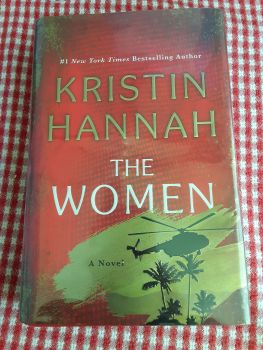
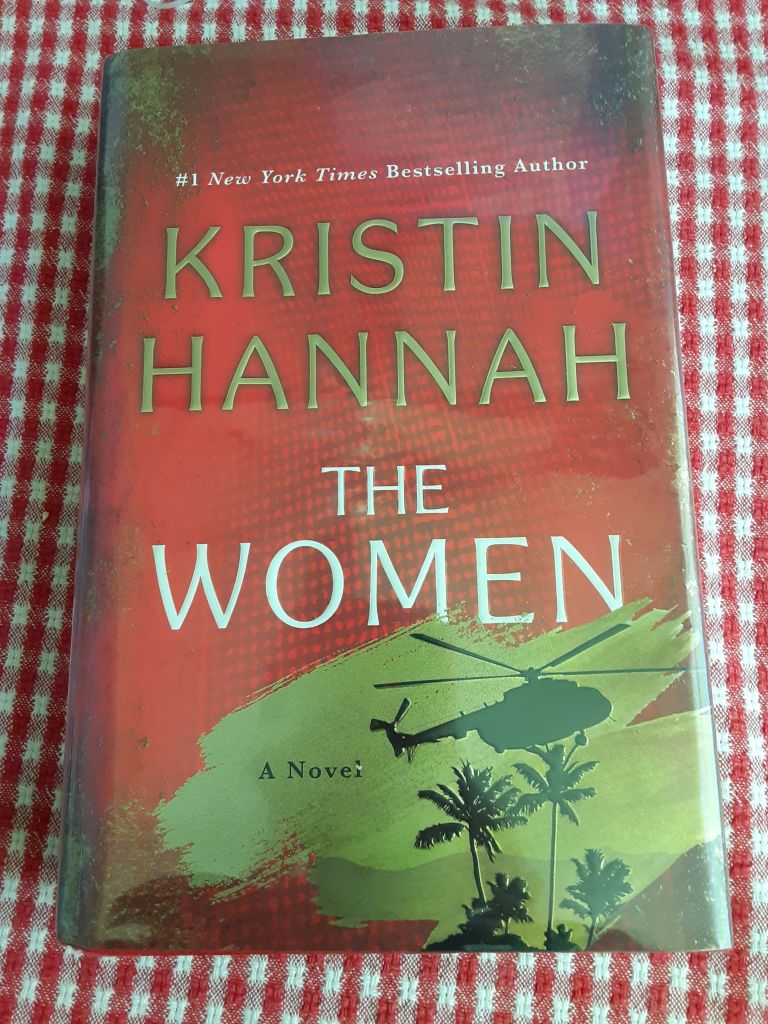
The Women
By Kristin Hannah (St. Martin’s Press, 2024)
Genre: Historical Fiction/Vietnam
Via: Library
Pages: 464 (Print)
If you’ve been reading with us for any length of time – say, 20 minutes or so – you know that Mom and I are singularly unimpressed by the words “Best-selling author.” Or its kissing cousins, “(fill in the blank) Award Winner” and “Over a bazillion copies in print.” The fact that everyone and their neighbor’s cat is crowing about a new release impresses us about as much as a plate of overcooked arugula.
Yea, verily. We’ve heaped praise on unknown indie authors who’ve earned it. We’ve also panned Pulitzer Prize winners who deserved it. Ya just never know.
So when we heard Kristin Hannah recently released her latest magnum opus about Vietnam combat nurses, we were a wee bit skeptical. The Women has been getting rave reviews. Does it live up to the hype?
Chops
Well. We checked out a copy from the library and decided to see what all the fooforah is about. To wit: We expect every title to earn its chops, not rest on past laurels. Besides. We learned a long time ago that just because something’s popular doesn’t mean it’s worth the paper its printed on (Hi, J.D. Salinger. Barf-o-rama). We just kinda sit back and say, “Prove it.”
We’re just funny that way.
Kimber: Well. You know Mom and I love historical fiction, right? Eat it up with the spoon. A double-fisted one. We’ve read a ton of HF. Most is set in WWII. Don’t know why. It just is. But The Women is the first historical fiction we’ve ever read set in and around the Vietnam War.
Now. One thing you may want to know about The Women is that it’s kind of like an accident on the freeway. You don’t want to look. But you always do. That’s what reading this book is like. There’s plenty we object to in the book. The book has a definite bias. And what is it with this author’s books and adultery? Geez. But we kept turning pages. Started it in the afternoon. Wanted to see how it panned out. Still kept turning pages. Until we turned the final page at 2:43 a.m. the next morning.
Nutshell Version
So… in a nutshell, The Women is the story of a naïve, idealistic and altruistic twenty-one year old, Frances “Frankie” McGrath, who volunteers to go to Vietnam as a nurse and comes home a different person.
Totally unprepared and woefully under-equipped, Frances gets the shock of her life when she arrives “in-country” in ‘Nam. But then, nothing in her sheltered Coronado, CA upbringing could’ve prepared her for the hell that is a 1960s field hospital in ‘Nam.
Barb and Ethel
Frankie’s “hooch” mates are two tough-as-nails combat nurses, Barb and Ethel. They’re brutally honest. They’re also indefatigably loyal. The unbreakable bond between these three women is one of the strongest parts of this complex, intricate book.
Meanwhile, as the war rages in Southeast Asia, American society crumbles along ‘Nam fault lines where the “generation gap” yawns and widens, Grand Canyon-esque, and seems un-bridgeable. Upon Frankie’s return “back in the world,” she faces another kind of “war”: A country bristling with hostility toward Vietnam vets and a complete denial of her role as a combat nurse and her military service.
Back to the story. As Frankie’s first year in-country winds down, she wonders how she’ll leave the hospital and the casualties – American and South Vietnamese – who need her? “She’d come here to make a difference, to save lives, and God knew lives still needed saving. As much as she sometimes hated the war, she loved nursing more.”
Over the vociferous objections of her parents, Frankie extends her tour of duty another year.
Home in Coronado after her second tour ends, Frances struggles with the cognitive dissonance of returning to country club life and cocktail lunches while a war is raging, people are dying in Vietnam, and there are protests in the streets. And why is she being spat upon and called a “baby killer”?
Frances also wonders how you go from red alert sirens, incoming mortar fire and saving lives to starched white uniforms, pantyhose and heels?
Adding insult to injury, Frances finds out that even her dad is ashamed about her military service. He’s lied about her absence, telling his Coronado Island friends that Frances has been “studying abroad.” Lunching at their country club with her mom later, Frankie is furious when she tells “an elderly man with walrus jowls” that she’s just returned from two tours in Vietnam and the man responds, “There are no women in Vietnam, dear.”
What’s an Army combat nurse to do when she comes home from not one but two tours in Vietnam to find her own parents are ashamed of her service and society refuses to believe she did what she did?
It’s enough to make you want to hawk up a hairball.
After a couple failed romances, Frankie turns to booze and pills to numb her omnipresent anger, fear, grief and sorrow. There’s also betrayal. Lies. Guilt. “Some things don’t bear the weight of words.” MLK, Malcom X, and the Black Panthers. The Kennedy assassination. Watler Cronkite and the Tet Offensive. The Hanoi Hilton. Richard Nixon. I Heard it Through the Grapevine. Born to Be Wild. My Lai. Wounds both physical and mental. The Doors. An IBM Selectric (For you youngin’s, that’s what “computers” were back when dinosaurs roamed the earth). The steadying calm of riding horses. “Unbearable grief. So many dead and dying and lost.”
This is a story both gripping and horrifying. Staggering. Shattering. Emotionally exhausting. Heart-breaking. But it’s also gritty and resilient and eye-opening. It’s a story that needs to be told.
A masterful storyteller, Hannah peppers her novel with rich and robust characters like Barb and Ethel. These two combat nurses are forces of nature. You sooo don’t want to mess with Barb or Ethel. Tough as nails and no-nonsense, they’ll move heaven and earth to save your life.
And saves lives these women do. Not that anyone “back in the world” (the States) cares. Or even notices.
Speaking of which, it would’ve been easy for Hannah to take the easy way out as this novel winds down. Tie everything up in a pretty bow of predictability and happily-ever-afters. The plot actually gives Hannah several chances to do just that. She doesn’t take the bait. Instead, Hannah takes the more demanding and infinitely more complicated road of Realistic. It ain’t pretty. But it feels more authentic. Real. Like a battered old boonie hat. Faded regret. A small gray stone. “I’ve got you.” And “Welcome home and thank you.”
Oh, Really?
Meanwhile, “There were no women in Vietnam refrain” is a recurring refrain. Almost a mantra. Everyone insists that “There were no women in Vietnam.” Frankie’s (former) friends. The “useless VA.” Stateside hospitals. Even other veterans.
It’s like The Women are invisible.
And they were.
But no more.
‘We Were There’
That’s pretty much the point of this whole book. So if you don’t read it for any other reason, read it for the one summed up in its final line (preferably not at 2:43 a.m.):
“The women had a story to tell, even if the world wasn’t quite yet ready to hear it, and their story began with three simple words: We were there.”

Pages & Paws Rating
 Pages & Paws